Sacred Mahapurana
Position #7

Markandeya Purana

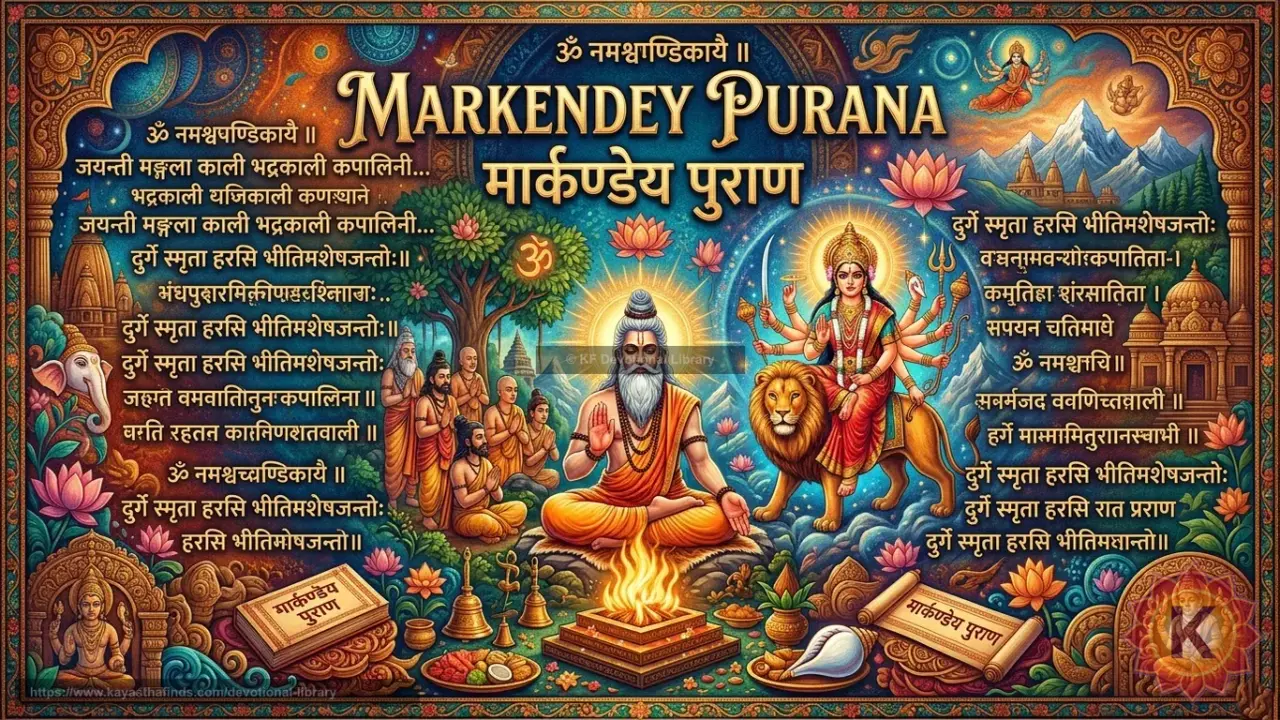
Explore the Markandeya Purana — one of Hinduism's oldest scriptures with 9,000 verses. Discover the Devi Mahatmya (Durga Saptashati), Durga vs Mahishasura, Navratri significance, and cosmic wisdom of Sage Markandeya.
Primary Deity

Durga (Devi)

Approx. Verses

9,000

Main Author

Maharishi Vedavyasa

Category

Mahapurana

Markandeya Purana

Join Our Devotional Community

Daily prayers, spiritual insights & divine blessings

Historical Essence

मार्कण्डेय पुराण अठारह महापुराणों में सबसे प्राचीन और दार्शनिक रूप से समृद्ध ग्रंथों में से एक है। इसमें १३७ अध्यायों में लगभग ९,००० संस्कृत श्लोक हैं। इसकी कथा शिव के परम भक्त ऋषि मार्कण्डेय द्वारा अपने शिष्य क्रौष्टुकि को सुनाई गई है। यह पुराण विशेष रूप से 'देवी माहात्म्य' के लिए प्रसिद्ध है, जिसे 'दुर्गा सप्तशती' या 'चंडी पाठ' भी कहा जाता है। यह ७०० श्लोकों का दिव्य स्तोत्र देवी दुर्गा की असुरों पर विजय का गुणगान करता है और शक्ति परंपरा का आधार स्तंभ है।

The Markandeya Purana is one of the oldest and most philosophically rich of the eighteen Mahapuranas, composed in approximately 9,000 Sanskrit verses across 137 chapters. It is narrated by the sage Markandeya — the ageless devotee of Shiva — to his disciple Kraustuki. The Purana is celebrated above all for the Devi Mahatmya, also known as the Durga Saptashati or Chandi Path, a 700-verse hymn glorifying the Goddess Durga's victory over demonic forces. This hymn is the foundational scripture of the Shakta tradition and is chanted across India during Navratri.

Sacred Records

Cosmic Chronicles

  • Event {String(idx + 1).padStart(2, '0')}

    देवी माहात्म्य (दुर्गा सप्तशती): ७०० श्लोकों का वह महान पाठ जिसमें देवी दुर्गा द्वारा मधु-कैटभ, महिषासुर और शुंभ-निशुंभ के वध की कथा है।

    Devi Mahatmya (Chapters 81–93): 700-verse hymn to Goddess Durga narrating three great battles — Madhu-Kaitabha, Mahishasura Mardini, and Shumbha-Nishumbha — through which the Divine Mother destroys primordial evil


  • Event {String(idx + 1).padStart(2, '0')}

    देवी की उत्पत्ति: देवताओं के तेज से माँ दुर्गा का प्राकट्य, जो यह दर्शाता है कि 'शक्ति' ही परम ब्रह्मांडीय ऊर्जा है।

    The birth of Goddess Durga from the combined energy (tejas) of all gods when they were overpowered by Mahishasura — establishing the theology of Shakti as supreme cosmic power


  • Event {String(idx + 1).padStart(2, '0')}

    राजा हरिश्चंद्र की कथा: सत्य के लिए अपना सर्वस्व त्यागने वाले राजा हरिश्चंद्र की प्रेरणादायक कहानी जो सत्य (Satya) की महिमा सिखाती है।

    Story of the righteous king Harishchandra who maintained absolute truthfulness through every ordeal of loss, slavery, and grief — a timeless teaching on the power of satya (truth)


  • Event {String(idx + 1).padStart(2, '0')}

    पक्षी संवाद: चार ज्ञानी पक्षियों द्वारा ऋषि जैमिनी को सुनाया गया महाभारत की घटनाओं का दार्शनिक रहस्य।

    The Jaimini Bharata embedded within — a series of stories told by four wise birds (Crows) to the sage Jaimini, covering questions on fate, karma, and the meaning of cosmic events from the Mahabharata


  • Event {String(idx + 1).padStart(2, '0')}

    काल चक्र: युग, कल्प और मन्वंतर के माध्यम से समय की चक्रिय प्रकृति और सृष्टि के सृजन-विनाश का सूक्ष्म वर्णन।

    Philosophical dialogue between Sage Markandeya and Indra on the cyclical nature of time (Yugas, Kalpas, and Manvantaras), cosmic dissolution, and re-creation


  • Event {String(idx + 1).padStart(2, '0')}

    ऋषि मार्कण्डेय और मृत्युंजय: वह बालक जिसने अपनी भक्ति से साक्षात् यमराज को पराजित किया और शिव की कृपा से अमर (चिरंजीवी) बना।

    The story of Markandeya himself — the sage born with a short lifespan who conquered death (Yama) through the grace of Lord Shiva, becoming the eternal 'Chiranjeevi' (immortal)

Dharmic Teachings

Eternal wisdom preserved through millennia.

नारी शक्ति (Shakti) केवल एक देवी नहीं, बल्कि ब्रह्मांड की मूल ऊर्जा है। उत्पत्ति, स्थिति और लय सब उसी से उत्पन्न होते हैं।

The Devi Mahatmya establishes that divine feminine power (Shakti) is not merely a goddess among gods, but the foundational energy of the cosmos — creation, maintenance, and dissolution all emerge from her

Verse 01

अधर्म चाहे कितना भी शक्तिशाली क्यों न हो, माँ जगदम्बा समय-समय पर अवतार लेकर उसका नाश और धर्म की स्थापना करती हैं।

Evil (Adharma) can temporarily overwhelm even the gods — but the cosmos has a self-correcting mechanism in the form of the Mother Goddess who rises precisely when the world falls into greatest darkness

Verse 02

सत्य (Satya) केवल एक नैतिक गुण नहीं बल्कि एक ब्रह्मांडीय शक्ति है। हरिश्चंद्र का जीवन सिद्ध करता है कि सत्य अंततः विजयी होता है।

Absolute truthfulness (Satya), as demonstrated by Harishchandra, is not merely a moral virtue but a supreme spiritual force that ultimately transforms even the most tragic circumstances

Verse 03

समय चक्रिय है। हम और हमारा संसार अनंत चेतना के समुद्र में उठने वाली अस्थायी लहरों के समान हैं।

Cosmic time moves in vast, incomprehensible cycles — human civilizations, gods, and even creation itself are temporary waves within the infinite ocean of consciousness

Verse 04

मृत्यु पर विजय संभव है, यदि भक्त पूरी तरह से परमात्मा के चरणों में समर्पित हो जाए, जैसा कि मार्कण्डेय ऋषि ने कर दिखाया।

The immortality of Sage Markandeya — achieved through Shiva's grace — teaches that complete surrender to the divine transcends even death, the most feared of all limitations

Verse 05

Frequently Asked Questions

मार्कण्डेय पुराण में देवी माहात्म्य क्या है? | What is the Devi Mahatmya in the Markandeya Purana?
यह पुराण के ८१ से ९३ अध्याय हैं, जिन्हें 'दुर्गा सप्तशती' कहा जाता है। इसमें देवी द्वारा मधु-कैटभ, महिषासुर और शुंभ-निशुंभ के संहार का वर्णन है।
The Devi Mahatmya (also called Durga Saptashati or Chandi Path) comprises chapters 81 to 93 of the Markandeya Purana — a continuous 700-verse hymn narrating the Goddess Durga's three cosmic victories: against Madhu and Kaitabha (birth of the world crisis), against Mahishasura the buffalo demon (the famous Mahishasura Mardini form), and against the brothers Shumbha and Nishumbha. Each battle represents Shakti overpowering different aspects of cosmic evil and is chanted as a complete liturgical unit during Navratri.
ऋषि मार्कण्डेय कौन हैं और उन्हें चिरंजीवी क्यों कहा जाता है? | Who is Sage Markandeya and why is he called immortal?
मार्कण्डेय जी की आयु केवल १६ वर्ष थी। जब काल उन्हें लेने आया, तो उन्होंने शिवलिंग को गले लगा लिया। महादेव ने प्रकट होकर काल को भगा दिया और उन्हें अमरता का वरदान दिया।
Markandeya was born with a lifespan of only 16 years. When Yama (the god of death) arrived to take him at his ordained hour, Markandeya embraced the Shiva Linga in terror and prayer. Shiva emerged and kicked Yama away with his cosmic foot, declaring that Markandeya would live forever. Markandeya thus became a Chiranjeevi (immortal), and the Purana bearing his name is narrated through his eternal perspective — giving it a unique quality of timeless wisdom about cosmic cycles.
राजा हरिश्चंद्र की कथा का क्या महत्व है? | What is the significance of the Harishchandra story?
राजा हरिश्चंद्र ने सत्य की रक्षा के लिए अपना राज-पाट, पत्नी और पुत्र तक को दांव पर लगा दिया पर झूठ नहीं बोला। यह कथा सिखाती है कि सत्य ही सबसे बड़ा धर्म है।
King Harishchandra was known for absolute truthfulness. The sage Vishwamitra put him through extraordinary trials — he lost his kingdom, his wife, his son, and his own freedom (becoming a servant in a cremation ground). Yet through every ordeal, he never uttered a falsehood. Ultimately, the gods restored everything to him and declared him a supreme example of dharma. The story is a foundational teaching on how unwavering commitment to truth is itself a divine power that transforms fate.
नवरात्रि में मार्कण्डेय पुराण का उपयोग कैसे होता है? | How is the Markandeya Purana used in Navratri celebrations?
नवरात्रि के दौरान इस पुराण के ७०० श्लोकों का पाठ (दुर्गा सप्तशती) अनिवार्य माना जाता है। इसे एक मंत्र-शात्र की तरह पढ़ा जाता है जिससे नकारात्मक ऊर्जा का नाश होता है।
The Devi Mahatmya (Durga Saptashati) from the Markandeya Purana is chanted throughout the nine days of Navratri. Priests recite the complete 700 verses in one or multiple sessions, sometimes dividing it across three days to correspond to the three divine battles. In Bengal, Durga Puja pandals commission professional Chandipath (Devi Mahatmya recitation) throughout the four festival days. The text is considered a mantra-shastra — its verses having direct energetic effects when chanted with proper pronunciation and devotion.

Living Cultural Legacy

Vedic Heritage: The Markandeya Purana's Devi Mahatmya is arguably the most recited Hindu scripture after the Bhagavad Gita and the Hanuman Chalisa. During the nine nights of Navratri (celebrated twice a year), millions of Hindus chant the Durga Saptashati in homes, temples, and public pandals. The text is the canonical reference for Shakti Puja across Bengal (Durga Puja), Gujarat (Navratri Garba), and South India (Navaratri). The story of Mahishasura Mardini — the goddess slaying the buffalo demon — is one of the most frequently depicted scenes in Hindu temple sculpture from the Gupta period onward. The text is a living scripture recited daily by priests, sadhaks, and devotees in Shakta temples throughout the world.

Divine Lineage
Durga (Devi)
Sacred Volume
9,000 Shlokas

Continue Reading

Divine Library