What is a Yuga? (The 4 Ages) - युग क्या है? 4 युगों का रहस्य
Explore the Hindu concept of time. Learn about the 4 Yugas (Satya, Treta, Dvapara, and Kali Yuga) and the inevitable cycle of creation and destruction.
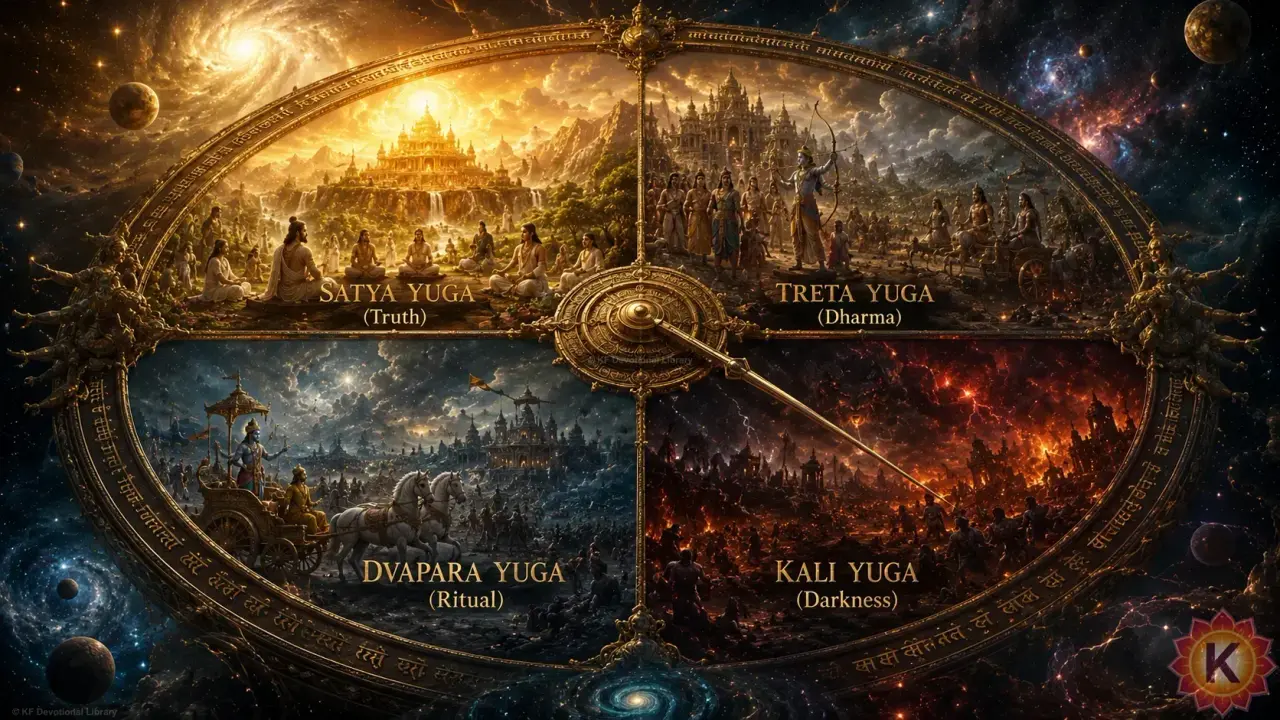
हिंदू धर्म में, समय एक सीधी रेखा नहीं है; यह एक अनंत चक्र है। 'युग' एक विशाल चार-भाग वाले चक्र (महा युग) के भीतर एक युग या काल है। चार युग हैं सत्य युग (सच्चाई का स्वर्ण युग), त्रेता युग, द्वापर युग, और अंत में कलि युग (अज्ञानता और संघर्ष का अंधकार युग)। हर युग के साथ, मानव नैतिकता और आध्यात्मिकता में भारी गिरावट आती है।
In Hinduism, time is not a straight line; it is an infinite circle. A 'Yuga' is an era or epoch within a massive four-part cycle known as a Maha Yuga. The four Yugas are Satya Yuga (the Golden Age of truth), Treta Yuga, Dvapara Yuga, and finally Kali Yuga (the Dark Age of ignorance and conflict). With each passing Yuga, human morality, lifespan, and spiritual intelligence drastically decline until the universe is destroyed and restarted.
Overview
आधुनिक पश्चिमी दृष्टिकोण के विपरीत कि इतिहास अंतहीन रूप से ऊपर की ओर बढ़ता है, हिंदू ब्रह्मांड विज्ञान जन्म, क्षय, विनाश और पुनर्जन्म के विशाल चक्रों पर काम करता है। जिस तरह पृथ्वी वसंत, ग्रीष्म, शरद ऋतु और सर्दियों के माध्यम से चक्र करती है, उसी तरह ब्रह्मांड चार युगों के माध्यम से चक्र करता है।
Unlike the modern Western view of history progressing endlessly upward, Hindu cosmology operates on massive cycles of birth, decay, destruction, and rebirth. Just as the Earth cycles through Spring, Summer, Autumn, and Winter, the universe cycles through the four Yugas. We are currently living in the spiritual winter: the Kali Yuga.
धर्म का बैल
The Bull of Dharma
शास्त्र अक्सर धर्म को चार पैरों वाले बैल—सत्य, पवित्रता, करुणा और तपस्या—के रूप में दर्शाते हैं। सत्य युग में, बैल चारों पैरों पर दृढ़ता से खड़ा होता है। त्रेता युग में, यह एक पैर खो देता है। द्वापर युग में, यह दो पर संतुलित होता है। आज, कलियुग में, धर्म का बैल एक पैर पर है। सत्य ही एकमात्र शेष स्तंभ है।
The scriptures often represent Dharma (righteousness) as a bull standing on four legs—truth, purity, compassion, and austerity. In Satya Yuga, the bull stands firmly on all four legs. In Treta Yuga, it loses a leg. In Dvapara Yuga, it balances precariously on two. Today, in Kali Yuga, the bull of Dharma hops on a single leg. Truth is the only remaining pillar, and even that is under constant attack by deceit and corruption.
कलियुग का अंत
The End of Kali Yuga
हम वर्तमान में कलियुग में लगभग 5,000 वर्ष आगे हैं। कल्कि पुराण जैसे ग्रंथों के अनुसार, समाज अंततः पूर्ण पर्यावरण पतन, लालच और नैतिक दिवालियापन की स्थिति में पहुंच जाएगा। बिल्कुल अंत में, भगवान कल्कि (विष्णु के 10वें अवतार) बुराई को खत्म करने और एक नए सत्य युग को जन्म देने के लिए पहुंचेंगे।
We are currently about 5,000 years into the Kali Yuga (which began shortly after Lord Krishna left Earth). According to texts like the Kalki Purana, society will eventually reach a state of absolute environmental collapse, greed, and moral bankruptcy. At the very end, Lord Kalki (the 10th avatar of Vishnu) will arrive on a white horse with a blazing sword to wipe the slate clean, ending the darkness and immediately giving birth to a new Satya Yuga.
Frequently Asked Questions
According to traditional calculations based on the Surya Siddhanta, Kali Yuga lasts for 432,000 human years. We are only in the very early stages of it.
Paradoxically, no. The scriptures say that because life is so difficult in Kali Yuga, the 'bar' for salvation is lowered. While sages in Satya Yuga meditated for thousands of years, in Kali Yuga, merely chanting the name of God with pure devotion (Nama Sankirtana) is enough to attain liberation.
Cultural Significance
Understanding the Yugas gives Hindus a profound sense of cosmic patience. While the news today might look terrifying, the cyclic view of time reassures believers that this decay is a natural, expected part of the cosmic season.
Disclaimer
The content provided on this page is for educational and informational purposes only. OneSanatan makes no claims or guarantees regarding spiritual results, historical absolute accuracy, or religious outcomes. We are not responsible or liable for any personal interpretations or actions taken based on this information.
Explore More Panchang Modules
Continue Reading