84 Lakh Yonis - 84 लाख योनियां
Explore the profound Hindu concept of 84 Lakh Yonis. Discover how the soul evolves through 8.4 million species, from aquatics to the rare human birth, guided by Karma.
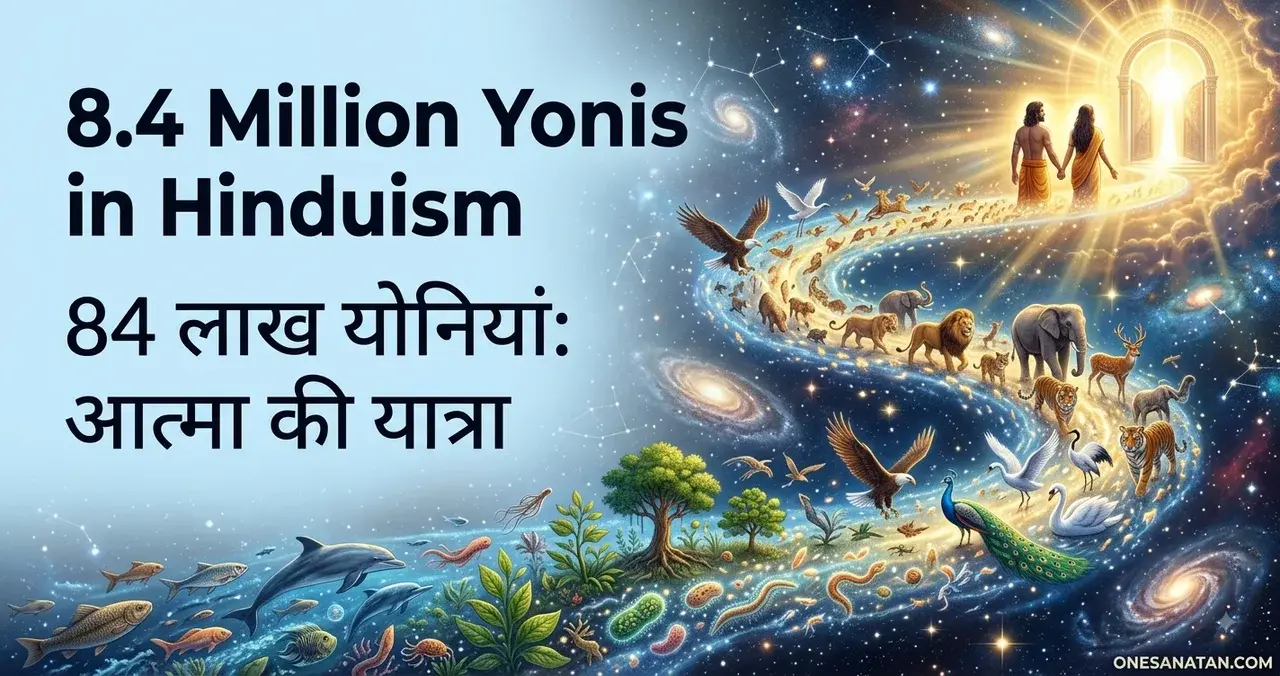
हिंदू धर्म के अनुसार, आत्मा को पुनर्जन्म के निरंतर चक्र में 84 लाख (8,400,000) विभिन्न प्रजातियों, जिन्हें 'योनि' कहा जाता है, से गुजरना पड़ता है। पद्म पुराण के अनुसार, इसमें जलचर, पेड़-पौधे, कीड़े-मकौड़े, पक्षी, पशु और अंत में मनुष्य शामिल हैं। मानव जन्म (कर्म योनि) सबसे अनमोल है, क्योंकि केवल इसी रूप में आत्मा के पास नए कर्म करने और मोक्ष प्राप्त करने की स्वतंत्र इच्छा होती है।
In Hinduism, the soul (Atman) must pass through 8,400,000 (84 lakh) distinct species, known as Yonis, in a continuous cycle of reincarnation. According to the Padma Purana, this includes aquatic creatures, plants, insects, birds, terrestrial animals, and finally, human beings. The human form (Karma Yoni) is the most precious, as it is the only state where the soul has free will to create new karma and achieve Moksha (ultimate liberation).
Overview
ब्रह्मांड अनंत है, और हिंदू दर्शन इसमें जीवन का एक अत्यंत विस्तृत ढांचा प्रस्तुत करता है। जबकि आधुनिक विज्ञान अभी भी नई प्रजातियों की खोज कर रहा है, प्राचीन हिंदू ग्रंथों जैसे 'पद्म पुराण' ने जीवन को 84 लाख विभिन्न रूपों या 'योनियों' में वर्गीकृत किया है। 'योनि' का अर्थ है 'गर्भ' या 'जीवन का स्रोत'। संसार (जन्म और मृत्यु के चक्र) की यात्रा में, अमर आत्मा सहस्राब्दियों तक इन लाखों जैविक रूपों से गुजरते हुए आध्यात्मिक रूप से विकसित होती है, जब तक कि उसे मानव जन्म का सौभाग्य नहीं मिल जाता।
The universe is endlessly vast, and Hindu philosophy offers a remarkably detailed framework of life within it. While modern science continues to discover new species, ancient Hindu texts like the Padma Purana precisely categorized life into 8.4 million distinct forms, or Yonis. The word 'Yoni' translates to 'womb' or 'source of life.' In the journey of Samsara (the cycle of birth and death), the immortal soul travels through these millions of biological forms, evolving spiritually over millennia until it finally earns the privilege of a human birth.
84 लाख योनियों का वर्गीकरण
The Breakdown of 8.4 Million Yonis
'पद्म पुराण' पृथ्वी पर सभी जीवित प्राणियों को छह प्राथमिक विकासवादी श्रेणियों में व्यवस्थित रूप से वर्गीकृत करता है। आत्मा चेतना की सबसे प्रारंभिक अवस्थाओं से शुरू होती है और ऊपर की ओर बढ़ती है। इसका विभाजन इस प्रकार है: 9 लाख जलचर, 20 लाख स्थावर (पेड़-पौधे), 11 लाख कृमि (कीड़े-मकौड़े और सरीसृप), 10 लाख पक्षी, 30 लाख पशु (जानवर), और 4 लाख मनुष्य प्रजातियां।
The Padma Purana systematically classifies all living entities on Earth into six primary evolutionary categories. The soul begins in the most basic states of consciousness and progresses upward. The division is as follows: 900,000 aquatic species (Jalchar), 2,000,000 immobile entities like trees and plants (Sthavar), 1,100,000 insects and reptiles (Krimi), 1,000,000 birds (Pakshi), 3,000,000 terrestrial animals (Pashu), and exactly 400,000 humanoid or human species (Manushya).
भोग योनि और कर्म योनि में अंतर
Bhoga Yoni vs. Karma Yoni
हिंदू दर्शन में 'भोग योनि' और 'कर्म योनि' के बीच एक महत्वपूर्ण अंतर है। 84 लाख रूपों में से, 80 लाख गैर-मानव प्रजातियां 'भोग योनि' (अनुभव के रूप) के अंतर्गत आती हैं। इन शरीरों में, आत्मा केवल अपने पिछले कर्मों को भोग रही होती है; वह वृत्ति (instinct) पर कार्य करती है और नए अच्छे या बुरे कर्म नहीं बना सकती। वहीं, मानव जन्म 'कर्म योनि' (कार्य का रूप) है। मनुष्यों के पास बुद्धि और स्वतंत्र इच्छा होती है, जिसका अर्थ है कि हमारे सचेत कार्य नए कर्म उत्पन्न करते हैं।
A vital distinction in Hindu philosophy is between Bhoga Yoni and Karma Yoni. Out of the 8.4 million forms, 8 million non-human species fall under Bhoga Yoni (Forms of Experience). In these bodies, the soul is merely burning off past karma; it acts on instinct and cannot create new good or bad karma. For instance, a predator hunting prey incurs no sin. However, the human form is the Karma Yoni (Form of Action). Humans possess intellect (Buddhi) and free will, meaning our conscious actions generate new karmic debts or merits.
परम लक्ष्य: मोक्ष (Liberation)
The Ultimate Goal: Liberation (Moksha)
इन लाखों योनियों को पार करने का अंतिम उद्देश्य बार-बार जन्म लेना नहीं है, बल्कि 'मोक्ष' प्राप्त करना है—जन्म और मृत्यु के चक्र से पूर्ण मुक्ति। मानव शरीर प्राप्त करना अत्यंत दुर्लभ और एक बहुत बड़ा ब्रह्मांडीय सौभाग्य माना जाता है। 84 लाख के इस चक्रव्यूह से बाहर निकलने का यह एकमात्र 'निकास द्वार' है। धर्म, भक्ति और ध्यान का पालन करके मनुष्य अपने वास्तविक ईश्वरीय स्वरूप को पहचान सकता है और परमात्मा में विलीन हो सकता है।
The ultimate purpose of traversing these millions of wombs is not to endlessly recycle, but to achieve Moksha—complete liberation from the cycle of birth and death. Attaining a human body is considered extremely rare and is a massive cosmic privilege. It is the only 'exit door' from the 8.4 million maze. By engaging in Dharma (righteousness), Bhakti (devotion), and Dhyana (meditation), a human being can realize their true divine nature and merge with the Supreme (Brahman).
Classification of the 8.4 Million Yonis (Padma Purana)
| Category (Sanskrit) | Form of Life | Number of Species (Yonis) |
|---|---|---|
| Jalchar | Aquatic creatures (living in water) | 900,000 (9 Lakh) |
| Sthavar | Immobile entities (trees, plants, mountains) | 2,000,000 (20 Lakh) |
| Krimi | Insects, worms, and reptiles | 1,100,000 (11 Lakh) |
| Pakshi | Birds and flying creatures | 1,000,000 (10 Lakh) |
| Pashu | Terrestrial animals (four-legged beasts) | 3,000,000 (30 Lakh) |
| Manushya | Humanoids and Human beings | 400,000 (4 Lakh) |
Frequently Asked Questions
Yes. If a human being lives a life devoid of Dharma, commits grave sins, and acts purely on animalistic instincts (greed, cruelty, excessive lust), their karmic weight can pull them back down into lower Yonis in their next life to burn off that negative karma.
Generally, animals are in a Bhoga Yoni and cannot generate the conscious karma required for Moksha. However, Hindu texts contain rare exceptions where animals received liberation purely through the direct grace of God, such as Gajendra (the elephant) or Jatayu (the eagle in Ramayana).
Interestingly, modern biology estimates there are around 8.7 million distinct eukaryotic species on Earth, which closely mirrors the ancient 8.4 million figure. However, in scripture, 'Yoni' can also represent different levels of consciousness or specific forms of subtle existence, not just biological taxonomy.
Cultural Significance
The concept of 84 Lakh Yonis instills a deep sense of reverence for all forms of life in Hindu culture, as every animal or plant is seen as a soul on its own evolutionary journey. Furthermore, it serves as a powerful spiritual wake-up call for humans. Scriptures like the Ramcharitmanas state, 'Bade bhagya manush tan pava' (It is by great fortune that one receives a human body). Wasting a human life purely on sensory pleasures—eating, sleeping, and mating—is seen as a tragic squandering of the opportunity to achieve spiritual enlightenment.
Disclaimer
The content provided on this page is for educational and informational purposes only. OneSanatan makes no claims or guarantees regarding spiritual results, historical absolute accuracy, or religious outcomes. We are not responsible or liable for any personal interpretations or actions taken based on this information.
Explore More Panchang Modules
Continue Reading