Reincarnation (Samsara) - पुनर्जन्म (संसार)
Discover how reincarnation works in Hinduism. Explore Samsara, the role of Karma, Vasanas, the immortal Atman, and how to break the cycle to achieve Moksha.
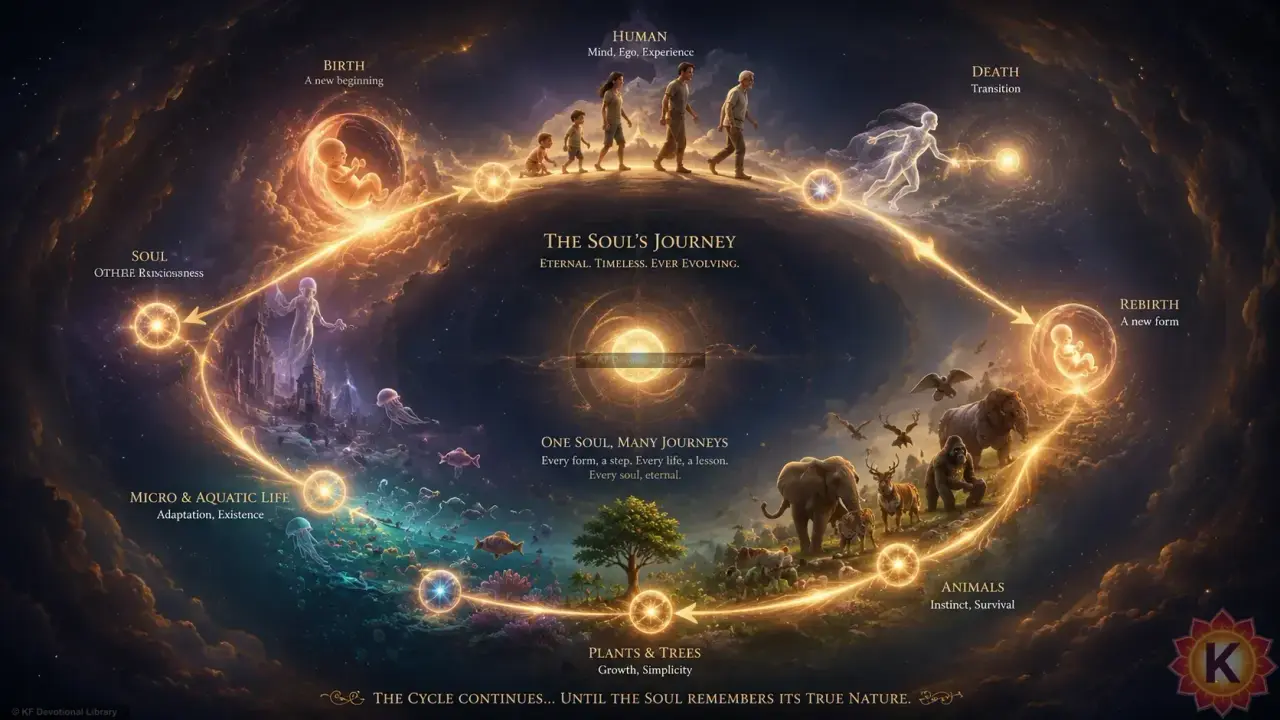
हिंदू धर्म में पुनर्जन्म (संसार) का अर्थ है कि भौतिक शरीर की मृत्यु होने पर अमर आत्मा (आत्मन) नए शरीर को धारण करती है। यह निरंतर चक्र व्यक्ति के कर्मों और अधूरी इच्छाओं (वासनाओं) द्वारा संचालित होता है। जब आत्मा आध्यात्मिक ज्ञान प्राप्त करके मोक्ष प्राप्त कर लेती है, तब इस जन्म-मरण के चक्र से मुक्ति मिलती है।
In Hinduism, reincarnation (Samsara) is the continuous cosmic process where the eternal, unchangeable soul (Atman) sheds a dying physical body and takes on a new one. Driven by accumulated Karma (actions) and Vasanas (subtle worldly desires), this cycle repeats across different life forms until the soul achieves spiritual realization and attains Moksha (liberation), merging with Supreme Consciousness.
Overview
जीवन को एक सीधी रेखा मानने के बजाय, हिंदू दर्शन इसे एक निरंतर चक्र (सर्कल) के रूप में देखता है जिसे 'संसार' कहा जाता है। 'संसार' संस्कृत शब्द से लिया गया है जिसका अर्थ है निरंतर बहना या चक्र में घूमना। इस दर्शन के केंद्र में अमर आत्मा (आत्मन) है, जो एक शरीर से दूसरे शरीर में वैसे ही यात्रा करती है जैसे कोई यात्री एक घर से दूसरे घर में जाता है। भगवद् गीता के दूसरे अध्याय में भगवान श्रीकृष्ण पुनर्जन्म की तुलना पुराने वस्त्रों को बदलकर नए वस्त्र धारण करने से करते हैं।
Unlike western traditions that view life as a single linear sequence ending in permanent judgment, Hindu philosophy sees existence as deeply cyclical—a continuous wheel of birth, life, death, and rebirth known as Samsara. The word Samsara derives from Sanskrit, meaning 'to flow together' or 'continuous wandering.' At the heart of this doctrine lies the indestructible soul (Atman), which moves from body to body just as a traveler moves from house to house. In Chapter 2 of the Bhagavad Gita, Lord Krishna delivers the definitive metaphor: 'Just as a person discards worn-out clothes and puts on new ones, the soul discards worn-out bodies and enters new, physical ones.'
पुनर्जन्म का इंजन: कर्म और वासनाएं
The Engine of Rebirth: How Karma and Vasanas Work
पुनर्जन्म कोई यादृच्छिक घटना नहीं है, बल्कि कर्म और वासनाओं द्वारा संचालित एक सटीक नियम है। हम जो भी विचार, शब्द या कार्य करते हैं, वह कर्म बनकर संचित होता है। संचित कर्म का एक हिस्सा (प्रारब्ध कर्म) हमारे वर्तमान जीवन को निर्धारित करता है। कर्मों के साथ-साथ 'वासनाएं' (सूक्ष्म इच्छाएं और मानसिक प्रभाव) भी होती हैं। मृत्यु के समय यदि आत्मा में सांसारिक सुखों, रिश्तों या धन की लालसा बनी रहती है, तो यही वासनाएं उसे एक नए भौतिक शरीर की ओर खींच ले जाती हैं।
Reincarnation is not a random cosmic punishment or reward; it is an exact cause-and-effect science governed by Karma and Vasanas. Karma refers to every intentional thought, word, and action. Accumulated karma (Sanchita Karma) forms the blueprint for future lives, while a specific portion (Prarabdha Karma) is allocated for the current lifetime. Alongside karma are Vasanas—subtle mental impressions and unfulfilled desires lingering in the subtle body (Sukshma Sharira). Upon death, if a soul remains bound by attachments to material wealth, relationships, or unfinished emotional business, these powerful Vasanas magnetize the soul toward a new physical body capable of fulfilling those exact desires.
सूक्ष्म शरीर और मृत्यु के बाद का संक्रमण
The Subtle Body and the Mechanics of Transition
जब किसी व्यक्ति की मृत्यु होती है, तो केवल स्थूल शरीर (भौतिक शरीर) का अंत होता है और वह पंचतत्वों में विलीन हो जाता है। लेकिन सूक्ष्म शरीर (जिसमें मन, बुद्धि, अहंकार और प्राण शामिल हैं) के साथ आत्मा पूरी तरह सुरक्षित रहती है। यह सूक्ष्म शरीर ही यादों, कर्मों और संस्कारों के पूरे डेटाबेस को लेकर मृत्यु के समय भौतिक शरीर से अलग होता है और अपने अगले पड़ाव की ओर यात्रा शुरू करता है।
When a person dies, only the gross physical body (Sthula Sharira) collapses and returns to the five elements (Pancha Bhoota). The underlying essence—comprising the soul (Atman) wrapped inside the subtle body (Sukshma Sharira)—remains completely intact. The subtle body contains the mind, intellect, ego, sensory faculties, and life force (Prana). Carrying the entire hard drive of memories, karmic balances, and deep-seated traits, this subtle vehicle detaches from the physical heart center at the moment of death and embarks on its journey toward the next physical womb best suited for its evolutionary needs.
84 लाख योनियों के माध्यम से आत्मा का विकास
Soul Evolution Through the Biological Forms
पद्म पुराण जैसे हिंदू ग्रंथों में पुनर्जन्म को आत्मा के विकास की एक सीढ़ी के रूप में वर्णित किया गया है। आत्मा 84 लाख योनियों (जलचर, स्थावर, कीड़े, पक्षी, पशु) से गुजरते हुए अंततः मानव जन्म प्राप्त करती है। पशु-पक्षी और अन्य गैर-मानव रूप केवल अपने पुराने कर्मों को भोगते हैं (भोग योनि)। वहीं मनुष्य का जन्म 'कर्म योनि' है, जहाँ स्वतंत्र इच्छा और विवेक से नए कर्म बनते हैं।
Hindu scriptures such as the Padma Purana describe reincarnation as a cosmic ladder of spiritual evolution. A soul progresses through 8.4 million species (Yonis)—ranging from aquatics, plants, insects, and birds to animals—before earning a human birth. In all non-human species (Bhoga Yoni), the soul acts purely on instinct, merely exhausting previous karma without accumulating new moral debts. Human birth (Karma Yoni) is exceptionally rare and precious because only humans possess Buddhi (higher intellect) and free will to consciously choose Dharma, create new karma, and seek spiritual realization.
संसार चक्र का अंत: मोक्ष का मार्ग
Breaking Samsara: The Ultimate Path to Moksha
हिंदू धर्म का अंतिम उद्देश्य बार-बार जन्म लेना या केवल स्वर्ग का आनंद लेना नहीं है, बल्कि संसार के इस चक्र को पूरी तरह समाप्त करना है। इस अवस्था को 'मोक्ष' कहते हैं। जब मनुष्य को अपने वास्तविक ईश्वरीय स्वरूप (ब्रह्म) का आत्मज्ञान हो जाता है, तब उसके सभी संचित कर्म ज्ञान की अग्नि में भस्म हो जाते हैं। वासनाएं नष्ट हो जाती हैं और आत्मा पुनः जन्म-मरण के चक्र में नहीं पड़ती।
The ultimate purpose of Hindu spiritual life is not to repeatedly enjoy heaven (Swarga) or achieve comfortable earthly reincarnations, but to exit the wheel of Samsara entirely. This state of liberation is called Moksha. When an individual realizes their non-dual oneness with the Supreme Reality (Brahman), all karmic seeds are burned in the fire of self-knowledge (Jnana). Desires dissolve, the ego surrenders, and upon physical death, the liberated soul (Jivanmukta) merges permanently with God, never to be bound by another physical body again.
Key Concepts and Mechanics of Reincarnation
| Philosophical Concept | Sanskrit Term | Role in the Rebirth Process |
|---|---|---|
| The Eternal Soul | Atman | The indestructible observer; takes on new bodies across lifetimes. |
| The Wheel of Rebirth | Samsara | The continuous cycle of birth, death, and reincarnation. |
| Universal Law of Cause & Effect | Karma | Determines the environment, family, health, and circumstances of the next life. |
| Subtle Desires & Impressions | Vasanas / Samskaras | The mental magnetic force pulling the soul toward a specific new body. |
| Subtle Vehicle | Sukshma Sharira | Carries mind, ego, and karmic records from the old body to the new womb. |
| Final Liberation | Moksha | The total destruction of karmic bonds and exit from the cycle of rebirth. |
Frequently Asked Questions
Forgetfulness of past lives is a merciful design of nature. The brain and memory belong to the physical body (Sthula Sharira), which decomposes at death. While the subtle body retains karmic tendencies (Samskaras), carry-over memory of past traumas, lost loved ones, or former enemies would overwhelm the mind and hinder progress in the current life's duties.
Yes, according to texts like the Bhagavad Gita and Garuda Purana. If a human persistently leads a life dominated by gross animalistic instincts—extreme cruelty, unrestrained lust, or deceit—their heavy karmic density can temporarily draw the soul down into animal forms (Bhoga Yoni) to burn off that negative karma before regaining a human birth.
There is no fixed timeframe. According to the Garuda Purana, the soul undergoes a 12-month cosmic journey through Yama Loka to settle its immediate karmic debts before taking a new womb. Depending on karmic readiness, desires, and environmental alignment, rebirth can happen almost instantly or take several earthly years.
Cultural Significance
The deep-seated belief in reincarnation profoundly shapes Hindu culture, ethics, and daily living. It introduces the principle of cosmic justice: no act goes unnoticed, and suffering is understood through the lens of karmic evolution rather than divine randomness. Furthermore, knowing that every living organism contains an evolving Atman fosters profound reverence for nature, animal welfare, and non-violence (Ahimsa). It encourages individuals to take absolute ownership of their present choices, knowing they are actively building their future destination.
Disclaimer
The content provided on this page is for educational and informational purposes only. OneSanatan makes no claims or guarantees regarding spiritual results, historical absolute accuracy, or religious outcomes. We are not responsible or liable for any personal interpretations or actions taken based on this information.
Explore More Panchang Modules
Continue Reading