What is Karma? Understanding Why Our Actions Matter - कर्म क्या है?
Discover the true meaning of Karma in Hinduism. Understand the universal law of cause and effect and learn why every action, word, and thought shapes your future.
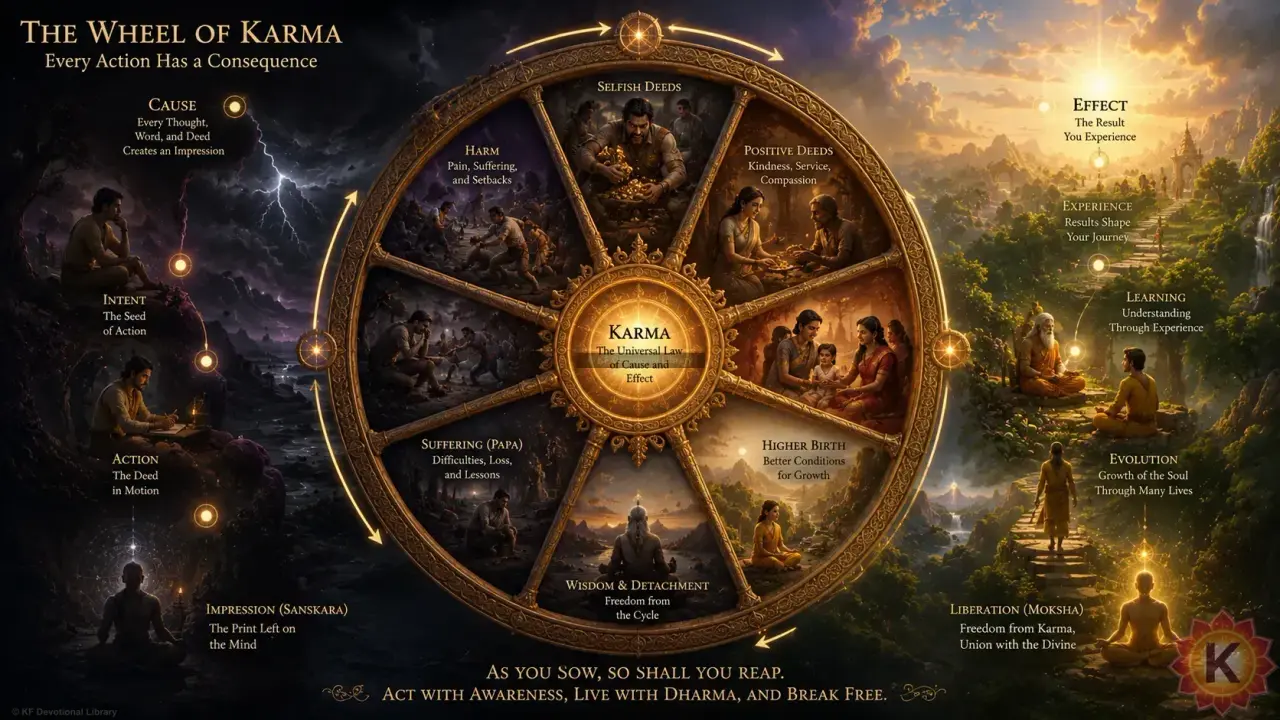
कर्म हिंदू धर्म में कारण और प्रभाव का सार्वभौमिक नियम है, जिसमें कहा गया है कि प्रत्येक क्रिया (शारीरिक, मानसिक या मौखिक) का एक अनिवार्य परिणाम होता है। यह किसी दिव्य न्यायाधीश द्वारा इनाम और सजा की प्रणाली नहीं है, बल्कि एक प्राकृतिक नियम है।
Karma is the universal law of cause and effect in Hinduism, stating that every physical action, spoken word, and thought generates an energy that will eventually return to the doer. It is not a system of divine reward or punishment, but a neutral law of nature where your present choices shape your future.
Overview
कर्म की अवधारणा को अक्सर 'भाग्य' या 'नियति' के रूप में गलत समझा जाता है। हालांकि, कर्म भाग्यवाद के विपरीत है। यह गतिशील क्रिया का दर्शन है। यह हमें बताता है कि हम अपने भविष्य के निर्माता हैं।
In modern Western culture, the word 'karma' is often used casually to mean a cosmic system of instant justice. However, in Sanatan Dharma (Hinduism), Karma is far more profound and scientific. Derived from the Sanskrit root 'Kri' (meaning 'to do' or 'to act'), Karma simply translates to 'action'. At its core, it is the universal law of cause and effect. It states that every physical action, spoken word, and even unspoken thought generates an energy that will eventually return to the doer. You are the architect of your own destiny, and your current life circumstances are the sum total of your past actions.
हमारे कर्म क्यों मायने रखते हैं?
Why Do Our Actions Matter?
वैश्विक परिप्रेक्ष्य में, कर्म की अवधारणा एक मौलिक मानवीय प्रश्न को संबोधित करती है: हमारे दैनिक विकल्प हमारी वास्तविकता को कैसे आकार देते हैं? हम जो भी कार्य करते हैं, वह एक विशिष्ट ऊर्जा उत्पन्न करता है जो हमारे भविष्य का निर्माण करती है।
From a broader perspective, the concept of Karma addresses a fundamental human question: Why do bad things happen to good people, and how do our daily choices shape our reality? Every action we take, word we speak, and thought we harbor generates a specific energy that ripples out into the universe. Karma teaches that we are not victims of a random, chaotic universe, but rather the active architects of our own destiny. Our actions matter because they are the exact seeds from which our future experiences will grow.
कर्म क्या नहीं है: गलतफहमियों को दूर करना
What Karma is NOT: Debunking Misconceptions
कर्म कोई सजा नहीं है; यह शैक्षिक है। यह तत्काल नहीं है; किसी कार्य का प्रभाव इस वर्तमान जीवनकाल में प्रकट नहीं हो सकता है। अंततः, यह भाग्यवाद नहीं है; कर्म में विश्वास करने का अर्थ हार मानना नहीं है।
For spiritual seekers and those new to Hinduism, it is crucial to unlearn popular misconceptions. Karma is not a punishment; it is educational and brings you the experiences needed to evolve spiritually. It is not immediate; the effects of an action may not manifest in this current lifetime. Finally, it is not fatalism; believing in Karma does not mean giving up. While your past actions shape your present circumstances, your present choices shape your future.
कर्म के तीन प्रकार (धनुर्विद्या का उदाहरण)
The Three Types of Karma (The Archery Analogy)
To truly understand how Karma operates across lifetimes—a concept central to reincarnation (Samsara)—ancient Vedic scholars categorized it into three types. The easiest way to understand them is through the analogy of an archer:
- 1. संचित कर्म (तरकश में तीर): पिछले सभी जन्मों के उन कार्यों का विशाल भंडार जिनका फल अभी मिलना बाकी है। — 1. Sanchita Karma (Arrows in the Quiver): The vast warehouse of all past actions from all previous lives that have not yet borne fruit.
- 2. प्रारब्ध कर्म (उड़ान में तीर): संचित कर्म का वह भाग जो परिपक्व हो चुका है और वर्तमान जीवन में अनुभव किया जा रहा है। इसे रोका नहीं जा सकता। — 2. Prarabdha Karma (Arrow in Flight): The portion of Sanchita Karma that has matured and is being experienced in the current life. It determines your family, physical traits, and major life events. Once shot, it cannot be stopped.
- 3. आगामी कर्म (निकाला जा रहा तीर): इस जीवन में किए जा रहे नए कार्य, जो भविष्य के परिणाम बनाएंगे। यहीं आपकी शक्ति निहित है। — 3. Agami Karma (Arrow Being Drawn): The new actions you perform in this life, which will create future consequences. This is where your power and free will lie.
स्वतंत्र इच्छा बनाम नियति: क्या आपके पास विकल्प है?
Free Will vs. Destiny: Do You Have a Choice?
हिंदू धर्म दृढ़ता से कहता है कि हाँ, आपके पास स्वतंत्र इच्छा है। आपका प्रारब्ध कर्म (पिछले कार्य) उस भाग्य को निर्धारित करता है जो आपको इस जीवन में मिला है, लेकिन आगामी कर्म (वर्तमान कार्य) यह है कि आप उस भाग्य के साथ कैसे खेलते हैं।
A common question for international audiences exploring Hinduism is: 'If my current life is the result of past Karma, do I even have free will?' Hinduism emphatically says yes. Your Prarabdha Karma (past actions) determines the hand of cards you are dealt in this life—that is your destiny. However, Agami Karma (current actions) is how you choose to play that hand—that is your free will. The Upanishads state that humans are gifted with intellect (Buddhi) to make conscious choices and break negative cycles.
आधुनिक प्रासंगिकता: निष्काम कर्म (बिना मोह के कर्म)
Modern Relevance: Nishkama Karma (Action Without Attachment)
भगवद गीता में, भगवान कृष्ण 'निष्काम कर्म' - इच्छा रहित कर्म की अवधारणा सिखाते हैं। जब हम कर्तव्य की भावना से कार्य करते हैं, बिना फल की चिंता किए, तो हम नए कर्म बंधन नहीं बनाते हैं। यह मोक्ष के करीब जाने का मार्ग है।
How do we apply this ancient wisdom to modern life and career stress? In the Bhagavad Gita, Lord Krishna teaches the concept of 'Nishkama Karma'—desireless action. He states, 'You have a right to perform your prescribed duty, but you are not entitled to the fruits of action.' In a high-pressure world, this teaches us to focus entirely on doing our absolute best in the present moment, without being emotionally paralyzed by the fear of failure. By acting purely out of duty (Dharma), we stop accumulating new karmic debt and move closer to spiritual liberation (Moksha).
Understanding the Mechanics of Karma
| Analogy | Karma Type | State |
|---|---|---|
| The whole granary (All past lives) | Sanchita | Stored potential |
| The flour being used today (Current life) | Prarabdha | Active experience |
| The new seeds being planted (Current choices) | Agami | Future potential |
Frequently Asked Questions
Destiny (Prarabdha) is the portion of your past Karma that you must experience in this lifetime. Karma, broadly, is the entire system of action and consequence. You cannot change your destiny, but you can create a new destiny for the future using your current free will (Agami Karma).
While Prarabdha Karma must be experienced, its intensity can be reduced through sincere prayer, meditation, charity (Daan), and spiritual knowledge. Most importantly, one can stop creating new negative Karma by acting with pure intentions.
No. Luck implies a random, meaningless event. Karma is a precise, scientific law of cause and effect. What seems like sudden 'good luck' or 'bad luck' is actually the maturation of a past action.
At the time of death, the physical body dies, but the soul (Atman) carries its accumulated Sanchita Karma into the next life. If your Karma is predominantly positive, you take a birth conducive to spiritual growth. Ultimate liberation (Moksha) is achieved when all Karma is dissolved.
Cultural Significance
The law of Karma is the foundation of Hindu ethics. It provides a logical explanation for the inequalities in life and encourages individuals to be kind, ethical, and responsible. It promotes the idea of 'Universal Justice', where no good deed goes unnoticed and no evil deed goes uncorrected by the natural order. It shifts a person from a victim mindset to a creator mindset.
Disclaimer
The content provided on this page is for educational and informational purposes only. OneSanatan makes no claims or guarantees regarding spiritual results, historical absolute accuracy, or religious outcomes. We are not responsible or liable for any personal interpretations or actions taken based on this information.
Explore More Panchang Modules
Continue Reading