What is Dharma? Understanding Your Purpose in Life - धर्म क्या है?
Discover the profound meaning of Dharma in Hinduism. Learn how Sanatana Dharma and Svadharma guide you to discover your true purpose in life.
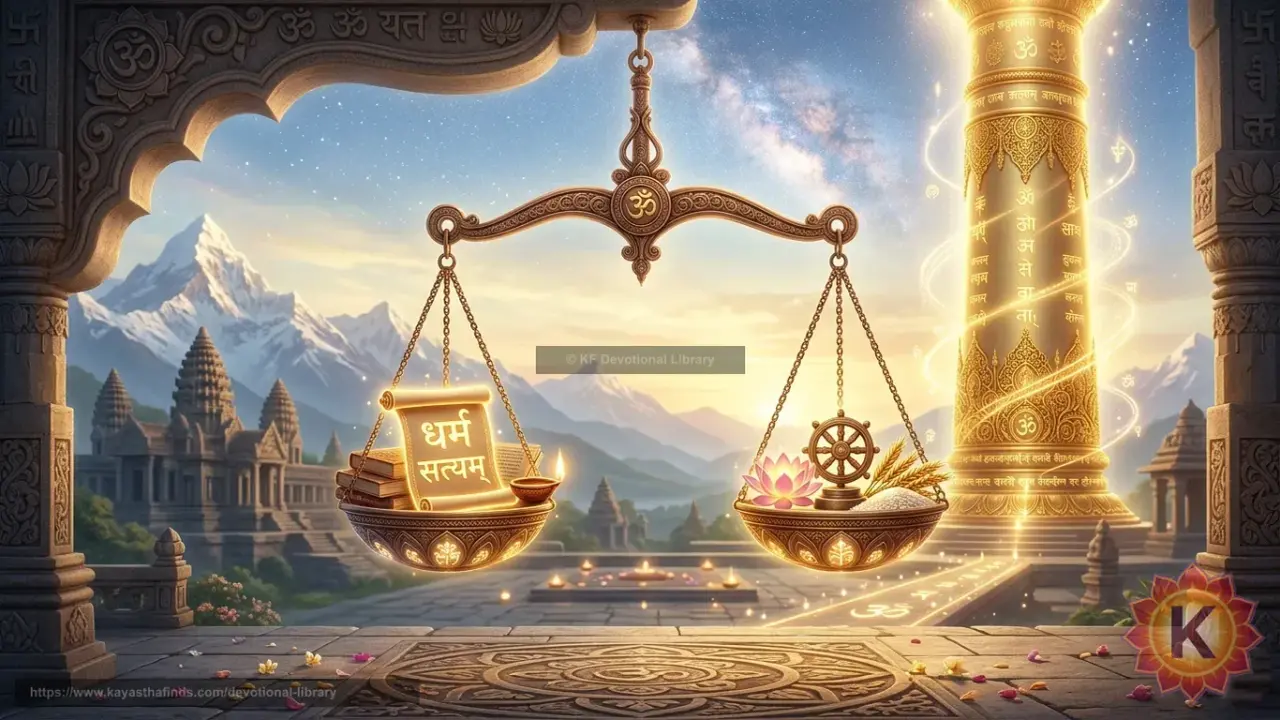
धर्म हिंदू धर्म में एक केंद्रीय अवधारणा है जिसका अर्थ 'सदाचार', 'कर्तव्य' और 'ब्रह्मांड का नैतिक आदेश' है। संस्कृत के मूल 'धृ' (धारण करना) से लिया गया है, यह उन व्यवहारों और कार्यों को संदर्भित करता है जो जीवन और ब्रह्मांड को बनाए रखते हैं।
Dharma is a central concept in Hinduism that signifies 'righteousness', 'duty', and 'the moral order of the universe'. Derived from the Sanskrit root 'dhri' (to uphold), it refers to the behaviors, ethical laws, and actions that sustain life and prevent the universe from falling into chaos. It is the foundational law that guides an individual to live in harmony with society and the divine.
Overview
धर्म शायद अंग्रेजी में अनुवाद करने के लिए सबसे कठिन शब्द है। यह सिर्फ धर्म से कहीं अधिक है; यह किसी वस्तु का आवश्यक स्वभाव और उससे उत्पन्न होने वाला कर्तव्य है। जैसे अग्नि का धर्म ऊष्मा है, वैसे ही मनुष्य का धर्म नैतिक नियमों और सदाचार के अनुसार जीना है।
Dharma is arguably the most profound and untranslatable concept in Sanatan Dharma (the native name for Hinduism). It is far more than just a set of religious rules; it is the essential nature of a thing and the moral duty that stems from it. Just as the dharma of sugar is sweetness, and the dharma of fire is heat, the dharma of a human being is to live according to moral laws, righteous conduct, and compassion. In the epic Mahabharata, it is famously declared, 'Dharmo Rakshati Rakshitah' — Dharma protects those who protect it. Understanding Dharma is the very first step for anyone seeking to understand the Hindu way of life.
जीवन में आपका उद्देश्य क्या है?
What Is Your Purpose in Life?
धर्म की अवधारणा अर्थ की खोज करने वाले किसी भी व्यक्ति के लिए एक गहरा ढांचा प्रदान करती है। धर्म सिखाता है कि सच्ची पूर्ति बाहरी इच्छाओं का पीछा करने से नहीं, बल्कि अपनी अद्वितीय आंतरिक प्रकृति और ब्रह्मांडीय नैतिक नियमों के साथ संरेखण में जीने से आती है।
For anyone searching for meaning, Dharma offers a profound framework. At its core, Dharma answers the ultimate question of purpose. While the modern world often equates purpose with career success or financial wealth, Dharma suggests that your true purpose is to live in alignment with your unique inner nature (Svadharma) and universal ethical laws (Sanatana Dharma). It teaches that true fulfillment comes not from chasing external desires, but from understanding your specific role in the universe and executing it with absolute integrity and selflessness.
धर्म बनाम मजहब: एक महत्वपूर्ण अंतर
Dharma vs. Religion: Debunking the Translation Myth
आधुनिक भाषा में, धर्म का अनुवाद अक्सर 'मजहब' के रूप में किया जाता है, लेकिन यह अधूरा है। मजहब एक विशिष्ट विश्वास प्रणाली को संदर्भित करता है। धर्म, अस्तित्व के अंतर्निहित नियमों को संदर्भित करता है।
For Western readers and spiritual seekers, a critical misconception must be cleared: Dharma is frequently, and incorrectly, translated as 'Religion' (e.g., Hindu Dharma = Hindu Religion). This is incomplete. A 'religion' often refers to a specific belief system, prophet, or faith that you can adopt or leave. Dharma, however, refers to the underlying laws of existence. You can change your religion, but you cannot change your Dharma—your essential duty to be truthful, compassionate, and responsible. Dharma is about 'doing' and 'being' rather than just 'believing'.
धर्म के विभिन्न स्तर
The Different Layers: Sanatana vs. Svadharma
Dharma is not a single, rigid commandment. It is highly dynamic, multi-layered, and adapts to the individual, the time, and the situation. Ancient Vedic texts divide it into several categories:
- 1. सनातन धर्म: शाश्वत, सार्वभौमिक नियम जो पूरी सृष्टि पर लागू होता है। — 1. Sanatana Dharma (The Eternal Law): The universal, unchanging moral values that apply to all humans regardless of age or background—such as truthfulness (Satya) and non-violence (Ahimsa).
- 2. स्वधर्म: अपनी प्रकृति और जिम्मेदारियों के आधार पर एक व्यक्ति का व्यक्तिगत कर्तव्य। — 2. Svadharma (Personal Duty): Your individual duty based on your unique nature, talents, and current stage of life. A soldier's Svadharma is to fight to protect, while a teacher's Svadharma is to educate.
- 3. वर्णाश्रम धर्म: सामाजिक भूमिका और जीवन के चरण से संबंधित कर्तव्य। — 3. Varnashrama Dharma (Social Duty): Duties related to one's societal role and specific stage of life (e.g., student, householder, retiree).
दैनिक जीवन में धर्म का व्यावहारिक अनुप्रयोग
The Cosmic Order (Rta) and Practical Application
धर्म के अनुसार जीने का अर्थ है ऐसे चुनाव करना जो सद्भाव और कल्याण को बढ़ावा दें। इसमें व्यक्तिगत लाभ के प्रति आसक्त हुए बिना अपने परिवार और समाज के प्रति कर्तव्यों का पालन करना शामिल है।
In the oldest Hindu scriptures, the Vedas, Dharma is closely linked to 'Rta'—the principle of natural order that regulates the cosmos (the changing of seasons, the orbits of planets). When humans follow Dharma, they align themselves with this cosmic rhythm. Practically, living according to Dharma means making choices that promote harmony, avoiding actions that cause unnecessary harm, and performing your duties to your family and society without selfish attachment. The Bhagavad Gita emphasizes that it is better to perform your own Svadharma imperfectly than to perfectly execute someone else's duty.
The Four Universal Pillars of Dharma (Samanya Dharma)
| Pillar (Sanskrit) | Meaning & Application |
|---|---|
| Satya | Truthfulness in thought, spoken word, and deed. |
| Tapas | Self-discipline, austerity, and controlling the senses. |
| Shaucha / Pavitrata | Purity of the physical body and the mind. |
| Daya | Deep compassion, empathy, and kindness toward all living beings. |
Frequently Asked Questions
The simplest definition of Dharma is 'right action' or 'duty'. It is the righteous way of living, acting, and thinking that sustains both the individual and the universe, preventing chaos.
Dharma is the moral law or the 'roadmap' of what you *should* do, while Karma is the actual 'action' you take and its consequence. Following Dharma ensures that your Karma leads to positive spiritual growth.
'Hinduism' is a geographical term given by outsiders. The original, authentic name is Sanatana Dharma, which translates to 'The Eternal Law' or 'The Eternal Way', representing truths that have existed since the beginning of time.
Ignoring your Dharma creates 'Adharma' (unrighteousness or chaos). On a personal level, it leads to internal conflict, suffering, and the accumulation of negative Karma, which delays spiritual liberation (Moksha).
Cultural Significance
Dharma is the foundational glue that holds Hindu society together. It provides a moral compass that has guided millions for thousands of years. It shifts the focus from 'What are my rights?' to 'What are my responsibilities?', teaching that true freedom and spiritual evolution come from selflessly fulfilling one's duties.
Disclaimer
The content provided on this page is for educational and informational purposes only. OneSanatan makes no claims or guarantees regarding spiritual results, historical absolute accuracy, or religious outcomes. We are not responsible or liable for any personal interpretations or actions taken based on this information.
Explore More Panchang Modules
Continue Reading