Who is Lord Shiva? - भगवान शिव कौन हैं?
Understand the identity of Lord Shiva, the Destroyer in the Hindu Trinity. Learn about his ascetic life, his family, and his role in the cosmic cycle.
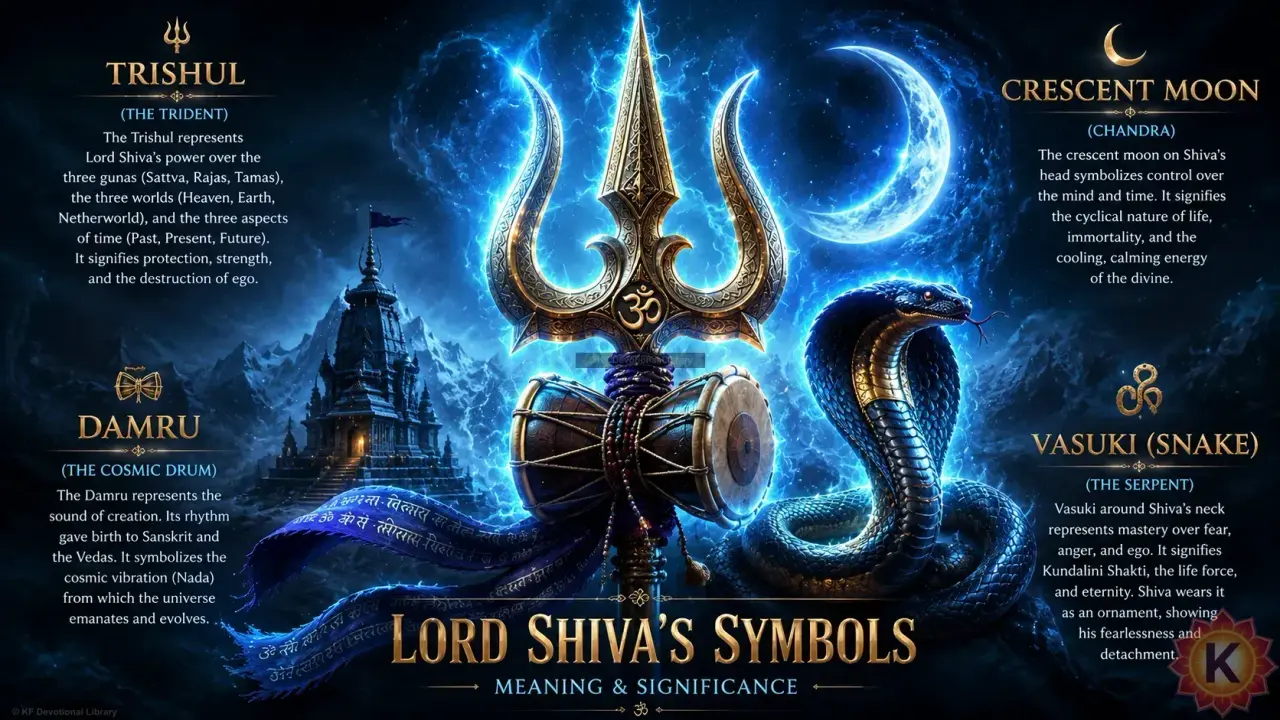
भगवान शिव, जिन्हें महादेव (महान देव) के रूप में भी जाना जाता है, हिंदू धर्म के प्राथमिक देवताओं में से एक हैं। वे 'त्रिमूर्ति' के भीतर 'संहारक' हैं। शिव एक जटिल देवता हैं जो पूर्ण स्थिरता और ब्रह्मांडीय गति दोनों का प्रतिनिधित्व करते हैं। वे योग और ध्यान के संरक्षक हैं, कैलाश पर्वत पर एक तपस्वी जीवन जीते हैं।
Lord Shiva, also known as Mahadeva (The Great God), is one of the primary deities of Hinduism. He is the 'Destroyer' within the Trimurti, the Hindu trinity that includes Brahma and Vishnu. Shiva is a complex deity representing both absolute stillness and cosmic motion. He is the patron of yoga and meditation, living an ascetic life on Mount Kailash, while also being a householder with his wife Parvati and their children. His destruction is not negative but a necessary transformation for new creation.
Overview
भगवान शिव को समझना वास्तविकता की अंतिम प्रकृति को समझना है। उन्हें अक्सर भस्म से ढकी त्वचा, जटाओं और सिर पर अर्धचंद्र के साथ चित्रित किया जाता है। वे 'भोलेनाथ' हैं।
To understand Lord Shiva is to understand the ultimate nature of reality. He is often depicted with ash-covered skin, matted hair, and a crescent moon on his head. He is 'Bholenath', the simple and kind lord who is easily pleased, and also 'Rudra', the fierce destroyer of evil. Shiva represents the 'Pure Consciousness' that remains when everything else in the universe is dissolved. Whether as the Adi Yogi (the first teacher of yoga) or the Nataraja (the lord of dance), Shiva's presence is felt in every atom of the universe.
संहारक: एक आवश्यक परिवर्तन
The Destroyer: A Necessary Transformation
हिंदू धर्म में, विनाश अंत नहीं है बल्कि एक सतत चक्र का हिस्सा है। शिव की संहारक के रूप में भूमिका 'माया' (भ्रम), अहंकार और अज्ञानता को समाप्त करना है।
In Hinduism, destruction is not the end but a part of a continuous cycle. Just as a seed must be destroyed for a plant to grow, the old and the decayed must be removed to make space for the new. Shiva's role as the destroyer is to eliminate 'Maya' (illusion), ego, and ignorance. By destroying the false self, he helps the soul realize its true, eternal nature. This is why his destruction is seen as a liberating and purifying force.
विरोधाभास: तपस्वी और गृहस्थ
The Paradox: Ascetic and Householder
शिव एकमात्र ऐसे देवता हैं जो दो विपरीत जीवनशैलियों को पूरी तरह संतुलित करते हैं। एक ओर, वे सर्वोच्च तपस्वी (महायोगी) हैं, तो दूसरी ओर, वे पार्वती के समर्पित पति और गणेश और कार्तिकेय के पिता हैं।
Shiva is the only deity who perfectly balances two opposite lifestyles. On one hand, he is the supreme ascetic (Maha Yogi) who spends thousands of years in deep meditation, disconnected from the world. On the other hand, he is a devoted husband to Parvati and a loving father to Ganesha and Kartikeya. This duality teaches that one can be deeply spiritual and connected to the divine while still fulfilling their duties in the material world.
कैलाश पर्वत: ब्रह्मांड की धुरी
Mount Kailash: The Axis of the Universe
अन्य देवताओं के विपरीत, जिनके पास स्वर्ग में भव्य महल हैं, शिव हिमालय में कैलाश पर्वत की चोटी पर निवास करते हैं। कैलाश केवल एक पर्वत नहीं है बल्कि आध्यात्मिक ऊर्जा का प्रतीक है।
Unlike other gods who have grand palaces in heaven, Shiva resides on the peak of Mount Kailash in the Himalayas. Kailash is not just a physical mountain but a symbol of the 'Sushumna Nadi', the central channel of spiritual energy in the human body. Living in the freezing cold among the snow, Shiva represents the state of mind that remains cool and undisturbed by the heat of worldly desires and emotions.
Primary Forms and Aspects of Shiva
| Form | Meaning / Aspect |
|---|---|
| Nataraja | The Lord of Dance; represents the cosmic cycle |
| Dakshinamurti | The silent teacher; represents the source of knowledge |
| Ardhanarishvara | Half-man, half-woman; represents the union of Shiva and Shakti |
| Mahakala | The Lord of Time; represents the ultimate destroyer |
| Pashupati | Lord of all beings; represents the protector of life |
| Lingam | The formless form; represents the infinite source of creation |
Frequently Asked Questions
Mahadeva literally means 'Great God' or 'God of Gods'. It signifies his supreme position as the source of all energy and the ultimate reality beyond all other forms.
The Lingam is a symbol of the formless (Nirguna) aspect of Shiva. It represents the infinite pillar of light from which the universe emerged and into which it will eventually dissolve.
His primary children are Lord Ganesha (the god of wisdom and obstacle removal) and Lord Kartikeya (also known as Murugan or Skanda, the god of war and victory).
Cultural Significance
The worship of Shiva is one of the oldest religious traditions in the world. From the 12 Jyotirlingas across India to the thousands of small shrines under trees, Shiva is everywhere. Festivals like Maha Shivratri and the holy month of Shravan are dedicated to him. He is the god of the masses, welcoming everyone from gods and kings to the outcasts and the animals.
Disclaimer
The content provided on this page is for educational and informational purposes only. OneSanatan makes no claims or guarantees regarding spiritual results, historical absolute accuracy, or religious outcomes. We are not responsible or liable for any personal interpretations or actions taken based on this information.
Explore More Panchang Modules
Continue Reading