Who is Lord Vishnu? - भगवान विष्णु कौन हैं?
Understand the role of Lord Vishnu in the Hindu Trimurti. Learn about his 10 avatars (Dashavatara), his symbols like the Sudarshana Chakra, and his role as the cosmic preserver.
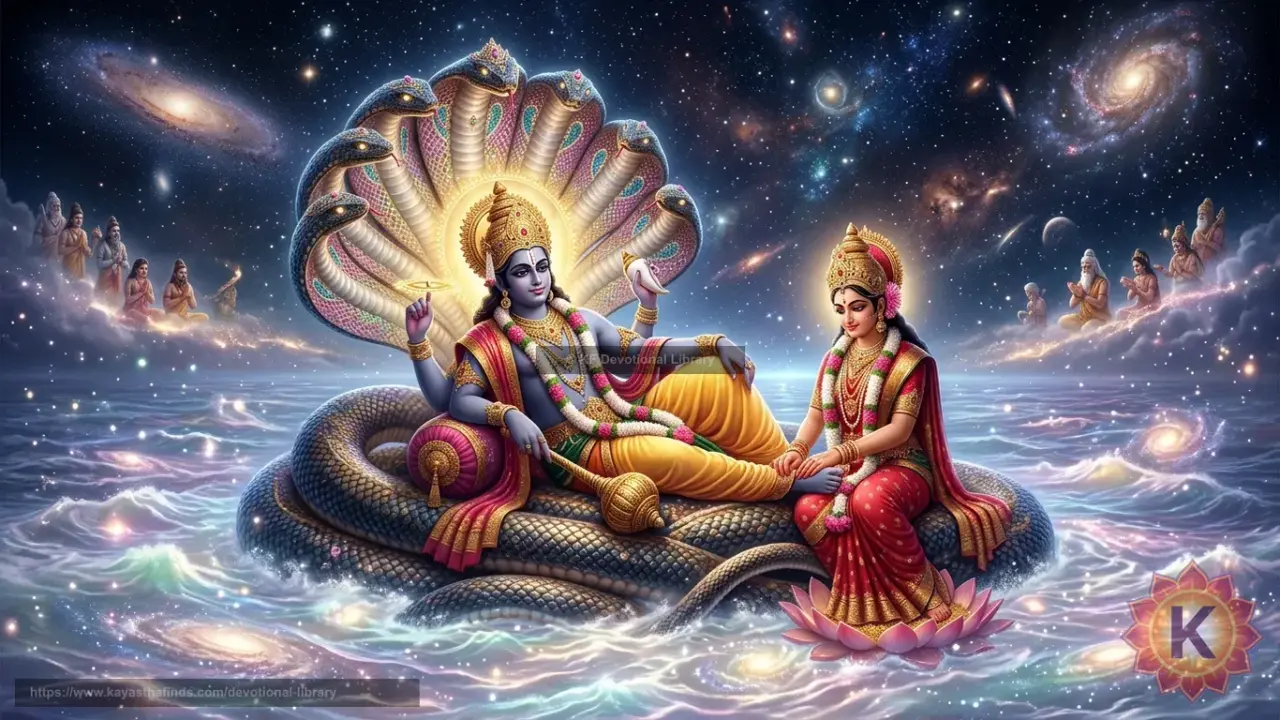
भगवान विष्णु हिंदू त्रिमूर्ति के दूसरे देवता हैं और उन्हें 'ब्रह्मांड के रक्षक और पालनहार' के रूप में पूजा जाता है। नारायण या हरि के नाम से भी जाने जाने वाले, वे दया और अच्छाई के प्रतीक हैं। जब भी धर्म पर संकट आता है, वे अवतार लेते हैं।
Lord Vishnu is the second deity of the Hindu Trimurti (Trinity) and is revered as the 'Preserver and Protector of the Universe'. Also known as Narayana or Hari, he is the embodiment of mercy and goodness. Whenever Dharma (righteousness) is threatened by chaos and evil, Vishnu incarnates on Earth in various avatars (such as Rama and Krishna) to restore cosmic balance.
Overview
वैष्णववाद में, विष्णु को सर्वोच्च सत्ता माना जाता है। उन्हें अक्सर क्षीर सागर में ब्रह्मांडीय सर्प आदिशेष पर विश्राम करते हुए चित्रित किया जाता है, जहाँ देवी लक्ष्मी उनके पैर दबा रही होती हैं।
In Vaishnavism, Vishnu is considered the Supreme Being. He is often depicted resting on the cosmic serpent Adishesha in the ocean of milk (Kshira Sagara), with Goddess Lakshmi massaging his feet. This imagery symbolizes his calm, steadfast nature in maintaining the complex order of the universe.
विष्णु के चार प्रतीक
The Four Symbols of Vishnu
भगवान विष्णु को चार भुजाओं के साथ चित्रित किया गया है, जिसमें वे शंख, सुदर्शन चक्र, कमल और गदा धारण करते हैं। ये क्रमशः ध्वनि, समय, पवित्रता और ज्ञान की शक्ति का प्रतिनिधित्व करते हैं।
Lord Vishnu is famously depicted with four arms, holding four sacred objects: 1. **Conch (Panchajanya)**: Represents the primordial sound 'Om' and the origin of existence. 2. **Discus (Sudarshana Chakra)**: The wheel of time and the weapon that destroys ego and ignorance. 3. **Lotus (Padma)**: Symbolizes purity, beauty, and the unfolding of creation. 4. **Mace (Kaumodaki)**: Represents elemental force and the power of knowledge.
दशावतार (10 अवतार)
The Dashavatara (10 Avatars)
धर्म को पुनर्स्थापित करने के लिए, विष्णु पृथ्वी पर 10 प्रमुख अवतार (दशावतार) लेते हैं: मत्स्य, कूर्म, वराह, नरसिंह, वामन, परशुराम, राम, कृष्ण, बुद्ध और कल्कि।
To restore Dharma, Vishnu takes form on Earth. The ten most famous incarnations (Dashavatara) are: Matsya (Fish), Kurma (Tortoise), Varaha (Boar), Narasimha (Half-man/Half-lion), Vamana (Dwarf), Parashurama (Warrior), Rama (Ideal King), Krishna (Divine Statesman), Buddha (The Enlightened One), and Kalki (The future destroyer of darkness).
Frequently Asked Questions
Narayana translates to 'The resting place of all living beings' or 'The one who rests on the waters of creation'. It highlights his role as the ultimate refuge.
The blue skin represents the infinite, formless nature of the divine, much like the boundless blue sky or the deep blue ocean.
Cultural Significance
Vishnu represents the sustaining, administrative force of the universe. The epics Ramayana and Mahabharata, centered around his avatars Rama and Krishna, form the cultural and moral foundation of India.
Disclaimer
The content provided on this page is for educational and informational purposes only. OneSanatan makes no claims or guarantees regarding spiritual results, historical absolute accuracy, or religious outcomes. We are not responsible or liable for any personal interpretations or actions taken based on this information.
Explore More Panchang Modules
Continue Reading