Kurma Purana
Explore the Kurma Purana — 17,000 verses on Vishnu's Kurma (tortoise) avatar, the Samudra Manthan (ocean churning), emergence of 14 divine treasures, Ishvaragita philosophy, and cosmic balance.
Primary Deity
Vishnu (Kurma avatar)Approx. Verses
17,000
Main Author
Maharishi Vedavyasa
Category
Mahapurana
Historical Essence
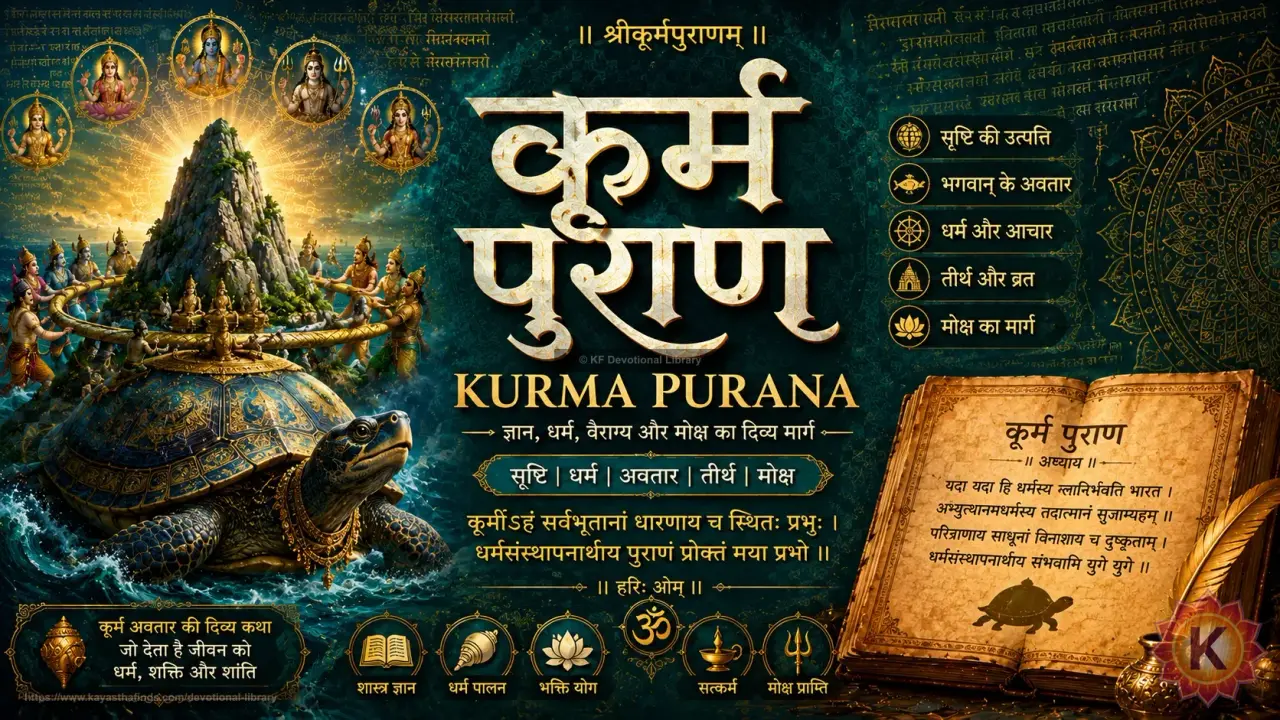
कूर्म पुराण एक अत्यंत महत्वपूर्ण महापुराण है, जिसमें लगभग १७,००० संस्कृत श्लोक हैं, जो दो मुख्य भागों (पूर्व और उत्तर विभाग) में विभाजित हैं। यह पुराण भगवान विष्णु के द्वितीय अवतार — 'कूर्म' (विशाल कछुआ) पर केंद्रित है। इसमें प्रसिद्ध 'समुद्र मंथन' की कथा का सविस्तार वर्णन है, जहाँ देवताओं और असुरों ने मिलकर अमृत प्राप्ति के लिए क्षीर सागर का मंथन किया था। इस मंथन में मंदराचल पर्वत को डूबने से बचाने के लिए भगवान विष्णु ने कूर्म रूप धरकर उसे अपनी पीठ पर धारण किया था।
The Kurma Purana is a significant Mahapurana comprising approximately 17,000 Sanskrit verses across two main sections (Purva and Uttara Vibhagas) and 18,000 verses in some recensions. Centered on Vishnu's Kurma (cosmic tortoise) avatar — his second incarnation — the Purana narrates the famous Samudra Manthan (churning of the cosmic ocean), one of the most celebrated myths in all of Hinduism, in which gods and demons cooperated to churn the primordial ocean using Mount Mandara as a churning rod and the serpent Vasuki as the rope, with Lord Vishnu as the Kurma supporting the mountain on his back.
Cosmic Chronicles
Dharmic Teachings
Eternal wisdom preserved through millennia.
समुद्र मंथन सिखाता है कि महान लक्ष्यों के लिए विपरीत शक्तियों के बीच सहयोग और एक निस्वार्थ आधार (कूर्म) की आवश्यकता होती है।
Samudra Manthan teaches that the greatest achievements require both cooperation between opposing forces and a stable, selfless foundation (the Kurma) that supports the entire enterprise without seeking recognition
हलाहल विष का निकलना यह दर्शाता है कि सफलता के मार्ग में सबसे बड़ी बाधा और संकट शुरुआत में ही आता है, जिसे शिव जैसी उच्च चेतना ही संभाल सकती है।
The Halahala poison that threatened to destroy creation before the Amrita could be obtained symbolizes that on the path to any great attainment, the most dangerous crisis comes precisely at the beginning — and must be addressed by Shiva's capacity to contain what others cannot
१४ रत्न बताते हैं कि संसार में वरदान और संकट दोनों साथ चलते हैं; विवेक इसी में है कि हम किसे और कैसे ग्रहण करते हैं।
The 14 Ratnas demonstrate that the cosmos contains both blessing and danger in equal measure — wisdom lies in knowing how to distribute each appropriately, as Vishnu's Mohini form demonstrated
ईश्वर गीता का सार है कि सर्वोच्च सत्य एक ही है; विष्णु और शिव एक ही चेतना के दो पूरक स्वरूप हैं।
The Ishvaragita's central teaching parallels the Bhagavad Gita: the supreme reality is one, underlying all forms — Vishnu and Shiva are not rivals but complementary aspects of the same ultimate consciousness
धैर्य और स्थिरता (कूर्म का प्रतीक) वे गुण हैं जिनके बिना बड़े से बड़ा प्रयास भी अंततः निष्फल होकर डूब जाता है।
Stability and patience (symbolized by the Kurma supporting immense weight on his back for the duration of the churning) are foundational virtues — without them, all other efforts — however powerful — will ultimately sink
Frequently Asked Questions
Living Cultural Legacy
समुद्र मंथन की कथा हिंदू कला और वास्तुकला का प्राण है। कंबोडिया के अंकोरवाट मंदिर की दीवारों पर इसके शानदार दृश्य आज भी सुरक्षित हैं। विश्व प्रसिद्ध 'कुंभ मेला' इसी मंथन से निकले अमृत की बूंदों की कथा पर आधारित है। आयुर्वेद के देवता भगवान धन्वंतरि इसी मंथन से कलश लेकर प्रकट हुए थे, जिनकी पूजा आज भी हम दीपावली से पूर्व 'धनतेरस' के रूप में करते हैं।
Vedic Heritage: The Samudra Manthan narrative from the Kurma Purana is one of the most visually represented stories in Hindu art and architecture — its depictions appear on the walls of Angkor Wat in Cambodia (12th century), across Khmer temple complexes in Southeast Asia, in paintings across Rajasthan and Kerala, and in modern Hindu calendars and temple murals. The Kumbh Mela — the world's largest peaceful human gathering — traces its theological basis to the Amrita drops that fell at four locations (Prayagraj, Haridwar, Nashik, and Ujjain) during the battle between gods and demons for the Amrita pot. Dhanvantari, who emerged from the Samudra Manthan holding the pot of Amrita, is the divine physician of Ayurveda — his Jayanti (birthday) is celebrated on Dhanteras (two days before Diwali) as the foundation of Ayurvedic medicine.
Disclaimer
Data provided (Tithi, Muhurta, Panchang details, etc.) is based on traditional Hindu calculations and is intended for cultural and educational purposes only and not a substitute for professional advice. For important rituals, ceremonies, or personal decisions, please consult a qualified Vedic astrologer or local priest.
Explore More Panchang Modules
Continue Reading