Sacred Mahapurana
Position #16

Matsya Purana

Explore the Matsya Purana — one of Hinduism's oldest scriptures with 14,000 verses. Discover the Matsya (fish) avatar, the great pralaya flood, King Manu's salvation, rescue of the Vedas, and ancient temple architecture guidelines.

Approx. Verses

14,000

Main Author

Maharishi Vedavyasa

Category

Mahapurana
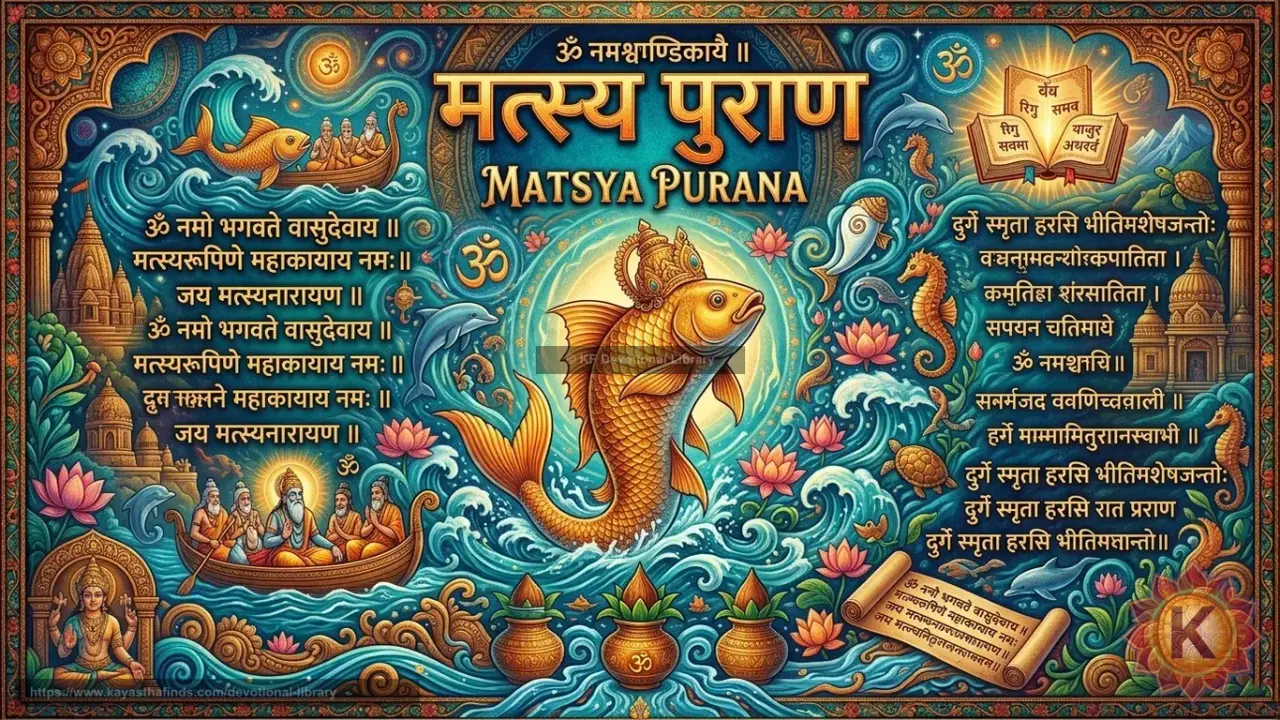
Matsya Purana

Join Our Devotional Community

Daily prayers, spiritual insights & divine blessings

Historical Essence

मत्स्य पुराण अठारह महापुराणों में सबसे प्राचीन और ऐतिहासिक रूप से महत्वपूर्ण ग्रंथों में से एक है। इसमें २९१ अध्यायों में लगभग १४,००० संस्कृत श्लोक हैं। यह पुराण भगवान विष्णु के प्रथम अवतार — 'मत्स्य' (मछली) पर आधारित है। इसमें प्रत्येक कल्प के अंत में आने वाले महाप्रलय (ब्रह्मांडीय बाढ़) का जीवंत वर्णन है। मत्स्य पुराण न केवल हिंदू धर्म की प्राचीनतम कथाओं को सुरक्षित रखता है, बल्कि इसमें मंदिर वास्तुकला (शिल्पशास्त्र), मूर्तिविज्ञान, मन्वंतर काल-चक्र और प्राचीन भारतीय राजवंशों की वंशावली का भी विस्तृत उल्लेख है।

The Matsya Purana is one of the oldest and most historically significant of the eighteen Mahapuranas, comprising approximately 14,000 Sanskrit verses across 291 chapters. Centered on Vishnu's Matsya (cosmic fish) avatar — his very first incarnation — the text narrates the great pralaya (cosmic flood) that periodically dissolves the world at the end of each Kalpa (cosmic epoch). The Matsya Purana preserves one of Hinduism's oldest narratives and is notable for containing detailed sections on temple architecture (Silpashastra), iconography, Manvantara time cycles, and a comprehensive account of ancient Indian dynasties and genealogies.

Sacred Records

Cosmic Chronicles

  • Event {String(idx + 1).padStart(2, '0')}

    मत्स्य अवतार की उत्पत्ति: राजा मनु के कमंडल में एक छोटी मछली का प्रकट होना, उसका तेज़ी से बढ़ना और अंततः भगवान विष्णु के रूप में प्रकट होकर प्रलय की चेतावनी देना।

    The Matsya avatar origin story: A small fish appears in King Manu's water pot, requests protection, grows exponentially large, and ultimately reveals itself as Vishnu — warning Manu of the imminent cosmic flood


  • Event {String(idx + 1).padStart(2, '0')}

    महाप्रलय की कथा: विशाल मत्स्य रूपी भगवान विष्णु द्वारा मनु की नाव (जिसमें सभी जीवों के बीज और सप्तर्षि सवार थे) को प्रलय के जल में सुरक्षित ले जाना।

    The great Pralaya (dissolution flood): How Vishnu as the giant cosmic fish guides Manu's boat — containing seeds of all life, pairs of all creatures, and the seven great sages (Saptarishis) — safely through the floodwaters for the duration of the cosmic night


  • Event {String(idx + 1).padStart(2, '0')}

    वेदों की रक्षा: शंखासुर दैत्य द्वारा ब्रह्मा जी से चुराए गए वेदों को मत्स्य अवतार द्वारा पुनः प्राप्त करना और पवित्र ज्ञान की रक्षा करना।

    Rescue of the Vedas: The demon Shankhasura had stolen the four Vedas from Brahma during his sleep before the flood. Vishnu as Matsya pursues and slays Shankhasura, recovering the Vedas and preserving sacred knowledge through the cosmic dissolution


  • Event {String(idx + 1).padStart(2, '0')}

    मन्वंतर काल-चक्र: १४ मन्वंतरों का सबसे विस्तृत वर्णन, जिसमें वर्तमान काल 'वैवस्वत मनु' (प्रलय से बचने वाले राजा) का सातवां मन्वंतर है।

    Manvantara cosmology: The most detailed Puranic account of the 14 Manvantaras — cosmic time periods each presided over by a distinct Manu — with the current Vaivasvata Manu (the flood survivor) being the seventh


  • Event {String(idx + 1).padStart(2, '0')}

    शिल्पशास्त्र (मंदिर निर्माण): हिंदू मंदिरों के निर्माण की बारीकियाँ — टावर (विमान) की माप, मूर्तियों का अनुपात और शिल्पकारों के नियम।

    Comprehensive Silpashastra (temple architecture) section: Detailed specifications for the construction of Hindu temples — measurements of the vimana (tower), proportions of deity images, qualifications for temple craftsmen, and consecration rituals


  • Event {String(idx + 1).padStart(2, '0')}

    राजवंश वंशावली: सूर्यवंश और चंद्रवंश के राजाओं की सूची, जो भारत के प्राचीन इतिहास को सुरक्षित रखने वाला एक महत्वपूर्ण दस्तावेज़ है।

    Extensive dynastic genealogies: King-lists of the Solar and Lunar dynasties from Manu through historical periods — preserving one of the most detailed ancient Indian historical records in any religious text


  • Event {String(idx + 1).padStart(2, '0')}

    पुष्कर तीर्थ: ब्रह्मा जी की यज्ञ स्थली पुष्कर झील की महिमा और विभिन्न व्रतों व खगोलीय गणनाओं का ज्ञान।

    Detailed treatment of vratas (sacred fasts), pilgrimage sites including Pushkar Lake (where Brahma performed a yajna), and astronomical knowledge for calculating auspicious times

Dharmic Teachings

Eternal wisdom preserved through millennia.

ईश्वरीय कृपा अक्सर अत्यंत सूक्ष्म रूप में प्रकट होती है। राजा मनु की तरह हमें उस छोटी सी कृपा को पहचानना और उसे पोषित करना सीखना चाहिए।

Vishnu's Matsya avatar teaches the foundational spiritual principle: divine grace manifests first as something small and apparently insignificant — the extraordinary begins as the ordinary, and wisdom lies in recognizing and nurturing this first small appearance of grace

Verse 01

प्रलय केवल विनाश नहीं बल्कि एक संशुद्धि है। प्रत्येक विनाश के बाद एक नए श्रेष्ठ जगत का सृजन होता है, जो सुरक्षित रखे गए प्राचीन ज्ञान (वेदों) पर आधारित होता है।

The great flood is not merely a catastrophe but a cosmic reset — the universe periodically dissolves and is recreated, and each cycle begins with a remnant of sacred knowledge and living beings preserved by divine grace for the next creation

Verse 02

बौद्धिक और आध्यात्मिक ज्ञान (वेद) का संरक्षण करना धन, वैभव या स्वयं के जीवन से भी अधिक महत्वपूर्ण है।

Preservation of sacred knowledge (the Vedas) in the face of chaos and destruction is one of the highest possible acts — more important than preserving wealth, power, or even individual lives

Verse 03

मानव इतिहास हमारी सोच से कहीं अधिक विशाल और चक्राकार है। मन्वंतर चक्र हमें सिखाते हैं कि हम इस अनंत समय-सरिता की एक छोटी सी बूंद मात्र हैं।

The 14 Manvantaras teach that human history is vastly longer and more cyclical than it appears to any individual lifespan — we are inhabitants of one small moment within immeasurably vast cosmic time-cycles

Verse 04

मंदिर निर्माण केवल ईंट-पत्थर का काम नहीं, बल्कि ब्रह्मांड की प्रतिकृति बनाना है। उचित अनुपात और भक्ति ही मंदिर को दिव्य ऊर्जा का केंद्र बनाते हैं।

Temple construction is a sacred science, not mere craft — the Matsya Purana's insistence on precise proportion, qualified craftsmen, and proper consecration signals that a temple is a microcosm of the universe and must be built with cosmic consciousness

Verse 05

Frequently Asked Questions

मत्स्य पुराण में मत्स्य अवतार की कहानी क्या है? | What is the Matsya avatar story in the Matsya Purana?
एक छोटी मछली राजा मनु से रक्षा माँगती है, जो तेज़ी से बढ़कर विशाल रूप ले लेती है और मनु को आने वाले प्रलय की चेतावनी देती है। भगवान विष्णु मत्स्य रूप में मनु की नाव को अपनी सींग से बांधकर प्रलय के दौरान सुरक्षित स्थान पर पहुँचाते हैं।
A small fish appears in the water pot of King Manu (the righteous progenitor of humanity) and begs for protection from bigger fish. Manu shelters it, and the fish grows rapidly — from a pot to a jar, then a lake, then the ocean. The fish finally reveals itself as Vishnu and warns Manu of the coming cosmic flood (Pralaya). Vishnu instructs Manu to build a great boat, load it with seeds of all plants, pairs of all living creatures, and the seven great sages. During the flood, the giant Matsya guides the boat using the serpent Vasuki as a rope, keeping Manu safe until the waters recede and a new world begins.
शंखासुर कौन था और उसे कैसे हराया गया? | Who is Shankhasura and how does the Matsya Purana describe his defeat?
शंखासुर वह असुर था जिसने ब्रह्मा जी की निद्रा का लाभ उठाकर वेदों को चुरा लिया था। भगवान विष्णु ने मछली का रूप धारण कर समुद्र की गहराइयों में उसका वध किया और वेदों को पुनः प्राप्त किया।
Shankhasura (the Conch demon) is described as a powerful asura who took advantage of Brahma's sleep at the end of the cosmic day to steal the four Vedas — the sacred knowledge repositories that make creation possible. He hid in the depths of the cosmic ocean. When the universe was threatened with eternal ignorance, Vishnu took the Matsya avatar not only to guide Manu through the flood but also to pursue Shankhasura into the ocean depths, slay him, and recover the Vedas — returning them to Brahma so that creation could begin anew in the next cosmic cycle.
मत्स्य पुराण के अनुसार मन्वंतर क्या है? | What is a Manvantara according to the Matsya Purana?
मन्वंतर एक बहुत बड़ा काल चक्र है (लगभग ३० करोड़ वर्ष)। प्रत्येक मन्वंतर का अपना एक 'मनु' (मानवता का पूर्वज) होता है। वर्तमान में हम सातवें मन्वंतर 'वैवस्वत मनु' के काल में रह रहे हैं।
A Manvantara is a vast cosmic time period presided over by a specific Manu — the progenitor-ruler of humanity during that era. The Matsya Purana's detailed cosmology describes 14 Manvantaras in each Kalpa (one complete day of Brahma, equal to 4.32 billion years). Each Manvantara lasts approximately 306 million years and has its own Manu, Indra, set of seven sages (Saptarishis), and group of gods. We currently live in the seventh Manvantara, presided over by Vaivasvata Manu — the one saved by the Matsya avatar in the flood story.
मत्स्य पुराण मंदिर वास्तुकला के बारे में क्या कहता है? | What does the Matsya Purana say about temple architecture?
इसमें मंदिर निर्माण के वैज्ञानिक नियम दिए गए हैं, जैसे गर्भगृह और शिखर का अनुपात, मूर्तिकला के तलमल नियम, और वास्तु पुरुष मंडल का प्रयोग, जो मंदिर को ऊर्जा का केंद्र बनाते हैं।
The Matsya Purana contains one of the most detailed Silpashastra (temple construction science) sections among all Puranas. It specifies the correct proportions for the various components of a Hindu temple — the garbhagriha (inner sanctum), ardhamandapa (anteroom), mandapa (assembly hall), and vimana (tower). It describes the talamana system (anthropometric ratios) for sculpting deities, the qualifications and rules for the Sthapati (master architect), the lunar calendar for commencing construction, and the Vastu Purusha Mandala — the cosmic grid that determines the spatial organization of sacred buildings.

Living Cultural Legacy

मत्स्य पुराण की प्रलय कथा का बाइबिल की नूह (Noah) की कथा और मेसोपोटामिया के 'गिलगामेश' महाकाव्य के साथ गहरा समानांतर है, जो प्राचीन विश्व की किसी बड़ी जल-प्रलय की याद दिलाता है। प्रख्यात पुष्कर झील, जहाँ ब्रह्मा जी ने यज्ञ किया था, इसी पुराण के कारण आज भी विश्व प्रसिद्ध तीर्थ स्थल है। इसके मंदिर वास्तुकला के नियम आज भी दक्षिण भारतीय और उत्तर भारतीय मंदिर निर्माण शैलियों के अध्ययन का आधार हैं।

Vedic Heritage: The Matsya Purana's flood narrative has attracted significant attention from comparative religion scholars who note its parallels with the Biblical story of Noah and the Mesopotamian Gilgamesh Epic — suggesting that great flood narratives may reflect universal memories of catastrophic ancient floods. In Hindu tradition, the story of Manu and the fish is foundational to the concept of Manvantara (cosmic age), and each of the 14 Manus is regarded as the progenitor of humanity in their respective cosmic period. The Matsya Purana's Silpashastra sections have been referenced by art historians studying temple construction in ancient and medieval India. The Pushkar Lake in Rajasthan — described in the Matsya Purana as the site of Brahma's great yajna — remains one of Hinduism's most sacred pilgrimage sites, hosting the famous Pushkar Camel Fair and Kartik Purnima bathing festival annually.

Divine Lineage
Vishnu (Matsya avatar)
Sacred Volume
14,000 Shlokas

Continue Reading

Divine Library