Sacred Mahapurana
Position #11

Linga Purana

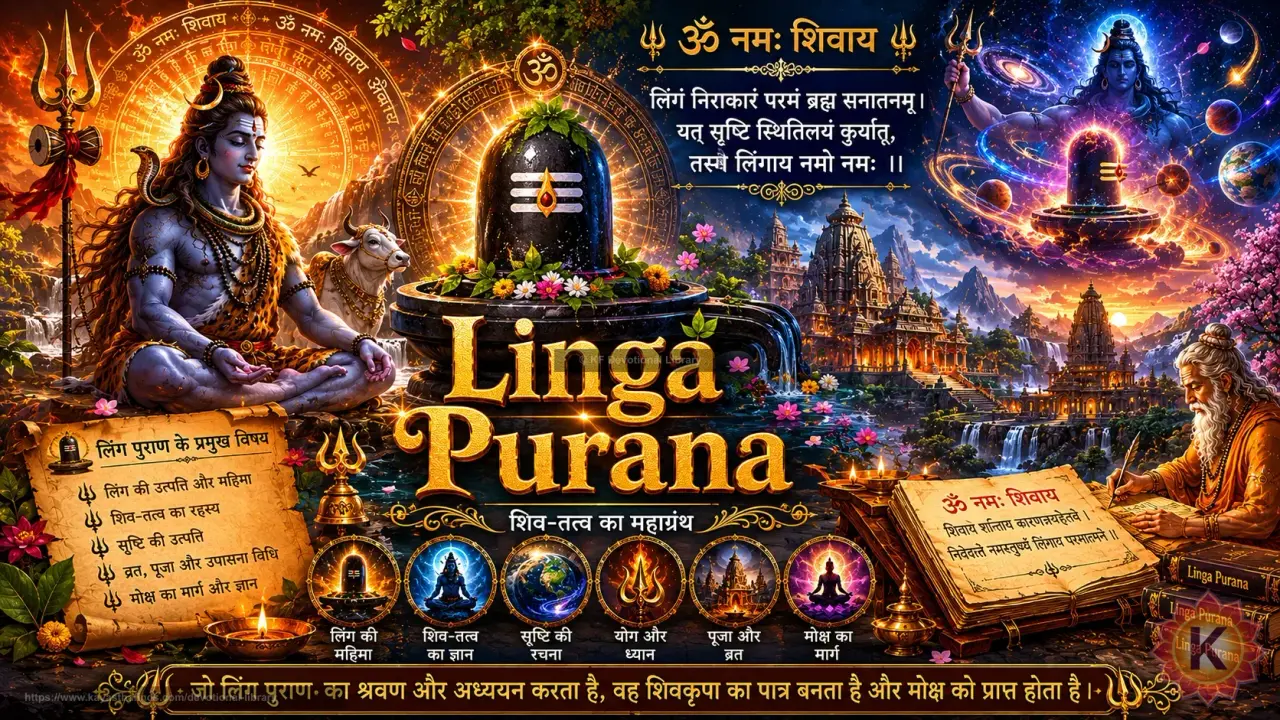
Explore the Linga Purana — 11,000 verses on the cosmic symbolism of the Shiva Linga, infinite pillar of light, 12 Jyotirlingas, Pashupata yoga, and Lord Shiva as Nirguna Brahman (formless absolute).
Primary Deity

Shiva

Approx. Verses

11,000

Main Author

Maharishi Vedavyasa

Category

Mahapurana

Linga Purana

Join Our Devotional Community

Daily prayers, spiritual insights & divine blessings

Historical Essence

लिंग पुराण भगवान शिव को समर्पित एक प्रमुख महापुराण है, जिसमें १६३ अध्यायों में लगभग ११,००० संस्कृत श्लोक हैं। इसका मुख्य दार्शनिक उद्देश्य 'शिव लिंग' के वास्तविक स्वरूप को समझाना है। यह लिंग को केवल एक प्रतीक नहीं, बल्कि ब्रह्मांड के उस अनंत, अनादि और शाश्वत 'ज्योति स्तंभ' के रूप में प्रस्तुत करता है जो निराकार ब्रह्म (Nirguna Brahman) का प्रतीक है। यह पुराण प्राचीन पाशुपत संप्रदाय के सिद्धांतों का आधार ग्रंथ है।

The Linga Purana is a principal Shaiva Mahapurana dedicated to Lord Shiva, composed in approximately 11,000 Sanskrit verses across two parts (Purva and Uttara) and 163 chapters. Its central philosophical concern is the understanding of the Shiva Linga — not as a phallic symbol but as the representation of the infinite, beginningless, eternal cosmic pillar of fire and light (Jyoti Stambha) that is the formless absolute (Nirguna Brahman). This text establishes the metaphysical and devotional foundations of the Pashupata school — the oldest known organized sect of Shaivism.

Sacred Records

Cosmic Chronicles

  • Event {String(idx + 1).padStart(2, '0')}

    ज्योति स्तंभ की कथा: जब ब्रह्मा और विष्णु में श्रेष्ठता को लेकर विवाद हुआ, तब शिव एक अनंत प्रकाश स्तंभ के रूप में प्रकट हुए जिसका न आदि था न अंत।

    The foundational myth of the Jyoti Stambha: Brahma and Vishnu dispute supremacy until a blazing pillar of infinite light (the Shiva Linga) appears — neither Brahma flying upward for thousands of years nor Vishnu diving downward can find its end, revealing Shiva as the infinite absolute


  • Event {String(idx + 1).padStart(2, '0')}

    सृष्टि और प्रलय: शिव द्वारा अपनी शक्ति के माध्यम से सृष्टि का सृजन और विनाश। लिंग और योनि को पुरुष (चेतना) और प्रकृति के मिलन का प्रतीक बताया गया है।

    Detailed cosmological account of Shiva creating and dissolving the universe through his Shakti — with the Linga and Yoni representing the union of Purusha (consciousness) and Prakriti (matter) that generates all existence


  • Event {String(idx + 1).padStart(2, '0')}

    १२ ज्योतिर्लिंग: उन स्थानों का वर्णन जहाँ शिव स्वयं ज्योति पुंज के रूप में प्रकट हुए और उनकी पूजा का महत्व।

    Complete list and mahatmya of the twelve Jyotirlingas — the self-manifested shrines where Shiva appeared as a pillar of light — with guidelines for pilgrimage and worship at each


  • Event {String(idx + 1).padStart(2, '0')}

    पाशुपत धर्म: शिव द्वारा सिखाया गया मुक्ति का मार्ग, जिसमें मनुष्य को 'पाश' (सांसारिक बंधनों) से मुक्त होकर 'पशुपति' (शिव) को प्राप्त करने की विधि है।

    Pashupata Dharma: The path of Pashupata yoga taught by Shiva as Pashupati — a radical system of liberation involving 5 stages: attainment of divine proximity through extreme austerity, cosmic initiation, liberation from all bondage (pasha), reality beyond bondage, and the final state of Brahman


  • Event {String(idx + 1).padStart(2, '0')}

    शिव के १००८ नाम: शिव के दिव्य नामों का संग्रह जो उनके गहन दार्शनिक और ब्रह्मांडीय रूपों को प्रकट करते हैं।

    108 sacred names of Shiva (Ashtottara Shatanamavali) and 1008 names (Sahasranama) with their metaphysical meanings and devotional significance


  • Event {String(idx + 1).padStart(2, '0')}

    महान भक्त गाथाएँ: दधीचि ऋषि जैसे महान शिव भक्तों की कहानियाँ जिन्होंने धर्म की रक्षा के लिए अपना सर्वस्व त्याग दिया।

    Stories of great Shiva devotees — including the sage Dadhichi who sacrificed his bones for the gods' weapons — as exemplars of supreme dedication


  • Event {String(idx + 1).padStart(2, '0')}

    अर्धनारीश्वर और नटराज: भगवान शिव के इन रूपों के माध्यम से समय, नृत्य और स्त्री-पुरुष ऊर्जा के संतुलन का दार्शनिक विवेचन।

    Philosophical exposition of Shiva as Mahakala (Lord of Time), Nataraja (cosmic dancer), and Ardhanarishvara (half-male, half-female), each form revealing a different cosmic function

Dharmic Teachings

Eternal wisdom preserved through millennia.

लिंग निराकार का प्रतीक है: शिव लिंग उस अनंत सत्य (Brahm) का प्रतिनिधित्व करता है जिसे बुद्धि से पकड़ा नहीं जा सकता और शब्द नहीं बांध सकते।

The Shiva Linga is the most philosophically sophisticated religious symbol in Hinduism — it represents the infinite, formless, attribute-less absolute (Nirguna Brahman) that cannot be grasped by mind, described by language, or bounded by space and time

Verse 01

चेतना का जागरण: शिव की पूजा का अर्थ है स्वयं की सीमित सोच से ऊपर उठकर उस निराकार चेतना की ओर मुड़ना जो हर कण में मौजूद है।

Shiva worship is not the worship of an anthropomorphic deity but the orientation of consciousness toward that which transcends all form — the Linga as a form of the formless is a paradoxical doorway to the beyond-conceptual

Verse 02

पाश से मुक्ति: हम सब 'पशु' (जीव) हैं जो मोह और अहंकार के 'पाश' (फंदे) में बंधे हैं। शिव ही पशुपति हैं जो इस फंदे को काट सकते हैं।

Pashupata yoga teaches that all beings are 'Pashus' (bound souls) held by 'Pasha' (cosmic bonds of karma, illusion, and ego) — liberation comes only through the grace of Pashupati (Shiva, the lord of all beings)

Verse 03

पंचकृत्य: शिव का नृत्य (नटराज रूप) सृष्टि के पांच कार्यों - सृजन, पालन, विनाश, माया और मोक्ष को दर्शाता है।

The cosmic dance of Nataraja encodes five divine acts: creation (Sristi), preservation (Sthiti), destruction (Samhara), concealment (Tirobhava), and grace/liberation (Anugraha) — all of which Shiva performs simultaneously in every moment

Verse 04

भक्ति से रूपांतरण: शिव भक्ति केवल स्वर्ग पाने के लिए नहीं, बल्कि स्वयं को एक ऐसी दृष्टि देने के लिए है जिससे हर जीव में शिव नजर आएं।

Genuine devotion to Shiva transforms the devotee — the path of Shaiva bhakti does not merely grant liberation but transforms the devotee into a Shivabhakta who sees the divine in all forms of existence

Verse 05

Frequently Asked Questions

लिंग पुराण के अनुसार शिव लिंग का वास्तविक अर्थ क्या है? | What is the real meaning of the Shiva Linga according to Linga Purana?
लिंग का अर्थ है 'प्रतीक'। यह उस अनंत ज्योति पुंज (प्रकाश स्तंभ) का प्रतीक है जिसका न आदि है न अंत। यह ब्रह्मा और विष्णु की श्रेष्ठता के विवाद के समय प्रकट हुआ था।
The Linga Purana explains that the Shiva Linga is not a phallic symbol but a representation of the infinite, formless cosmic pillar of light and consciousness (Jyoti Stambha). The text narrates that when Brahma and Vishnu competed for supremacy, a blazing pillar of fire appeared with no beginning or end — even after Brahma flew upward for millennia and Vishnu plunged downward as a boar, neither could find its limits. This infinite pillar is Shiva — the Nirguna Brahman (absolute without attributes), symbolized in temple worship as the Linga.
लिंग पुराण में वर्णित 'पाशुपत योग' क्या है? | What is Pashupata yoga described in the Linga Purana?
यह शिव को पाने का वह प्राचीन मार्ग है जिसमें मनुष्य अपनी अशुद्धियों और अहंकार (पाश) को त्याग कर महादेव (पशुपति) के साथ तादात्म्य स्थापित करता है।
Pashupata yoga is the liberation system described in the Linga Purana, attributed to Shiva as Pashupati (lord of all bound souls). It holds that all living beings are Pashus (souls bound by cosmic Pashas — the bonds of karma, maya, and ego) and that Shiva's grace alone can dissolve these bonds. The Pashupata path involves five progressive stages of practice: residing near Shiva temples, drawing ridicule from society (to burn off ego), solitary practice, dwelling at cremation grounds (confronting death), and finally merging with Shiva-consciousness. It is the oldest documented organized Shaiva sect.
लिंग पुराण में ज्योति स्तंभ की कथा क्या है? | What is the Jyoti Stambha story in the Linga Purana?
ब्रह्मा और विष्णु के बीच जब विवाद हुआ, तो एक विशाल अग्नि स्तंभ प्रकट हुआ। ब्रह्मा ऊपर गए, विष्णु नीचे, पर कोई छोर नहीं मिला। इससे सिद्ध हुआ कि महादेव ही सर्वोपरि और अनंत हैं।
In the Linga Purana, Brahma and Vishnu are disputing who is the supreme creator when a blazing pillar of infinite light — the Jyoti Stambha — suddenly appears between them, extending infinitely upward and downward. Brahma transforms into a goose (hamsa) and flies upward for thousands of years; Vishnu takes the form of a cosmic boar (Varaha) and dives downward for thousands of years — yet neither finds the pillar's end. Shiva then reveals himself as the source of the pillar, establishing his supremacy as Maheshvara — the great lord who transcends all creation.
लिंग पुराण में शिव के अर्धनारीश्वर रूप की क्या व्याख्या है? | How does the Linga Purana describe Shiva as Ardhanarishvara?
यह रूप दर्शाता है कि पुरुष (चेतना) और प्रकृति (शक्ति) अलग नहीं हैं। सृष्टि के लिए दोनों का मिलन आवश्यक है। लिंग और योनि भी इसी सत्य का निराकार चित्रण हैं।
The Linga Purana describes Ardhanarishvara — the half-male, half-female form of Shiva — as the cosmic statement that consciousness (Purusha/Shiva) and nature (Prakriti/Shakti) are inseparable. The right half is Shiva (white-complexioned, matted hair, trident) and the left half is Parvati (golden-complexioned, adorned with ornaments). This composite form teaches that creation cannot occur through either pure consciousness or pure matter alone — only their union generates existence. The Linga and Yoni together represent the same truth in abstract geometric form.

Living Cultural Legacy

यह पुराण दुनिया भर के लाखों शिव मंदिरों में होने वाली लिंग पूजा का मुख्य शास्त्रीय आधार है। 'ज्योति स्तंभ' की कथा आज भी शिवरात्रि और अन्य अवसरों पर प्रमुखता से सुनाई जाती है।

Vedic Heritage: The Linga Purana is the primary scriptural authority for the theology of Shiva Linga worship practiced across the approximately 200,000 Shiva temples spread throughout India and the diaspora. Its account of the Jyoti Stambha — the infinite pillar of light that neither Brahma nor Vishnu could comprehend — is the most frequently narrated story in Shaiva religious discourse, explaining why the Linga takes precedence over all other forms of divine representation in Shaivism. The Pashupata tradition it establishes influenced the later Shaiva Siddhanta, Kashmir Shaivism, and Nath traditions. The 108 and 1008 names of Shiva contained within it are recited daily by millions of devotees across the world's Shiva temples.

Divine Lineage
Shiva
Sacred Volume
11,000 Shlokas

Continue Reading

Divine Library